


Open access scientific publication on the strategic results of Italy-Croatia consortium about the blue crab invasion stages and mitigation in Adriatic Sea
16/06/2026
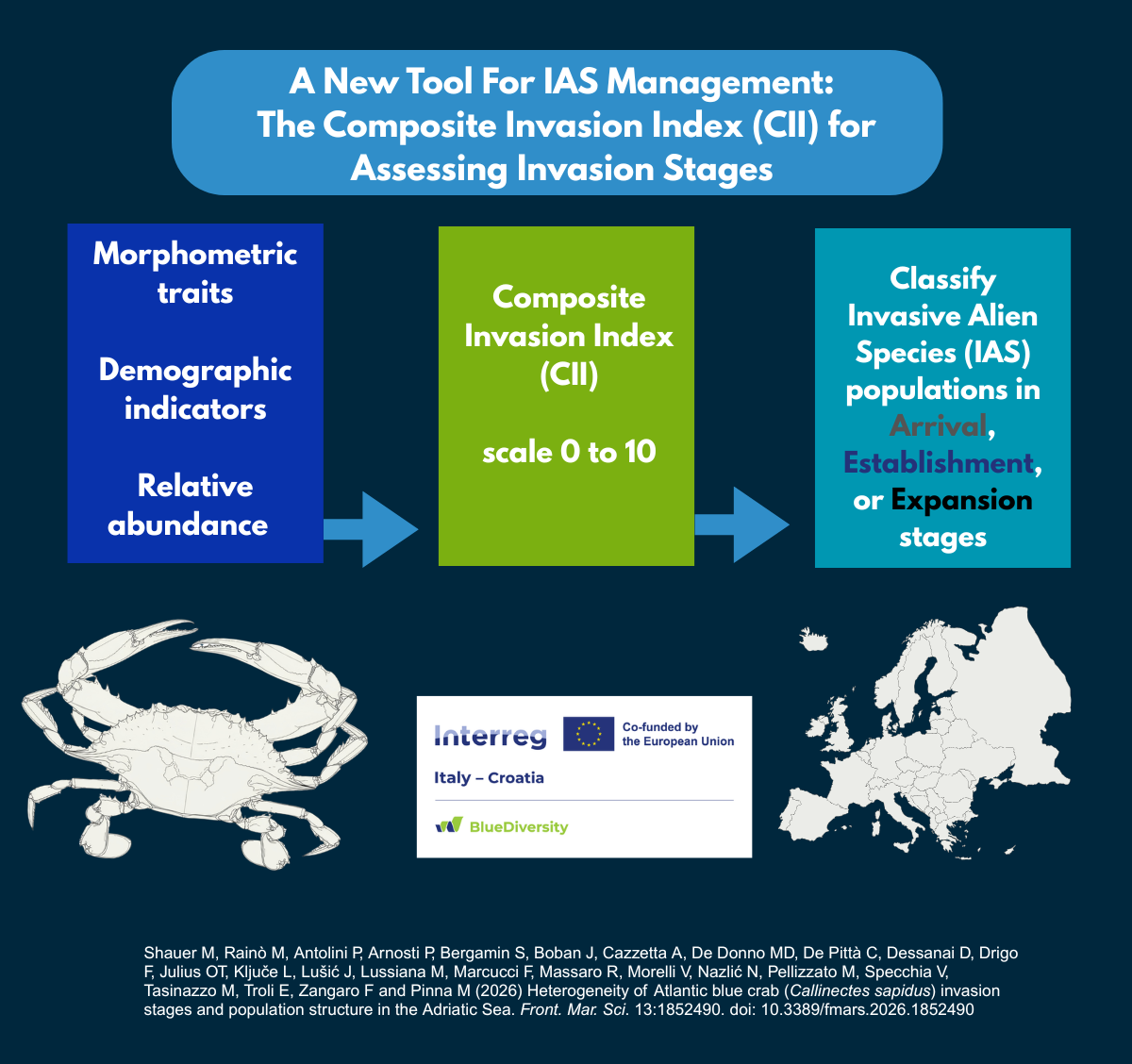
We are proud to announce the publication of the scientific paper entitled Heterogeneity of Atlantic blue crab (Callinectes sapidus) invasion stages and population structure in the Adriatic Sea in the renowned international journal Frontiers in Marine Science. This major scientific milestone represents the culmination of international collaboration and the synergistic efforts made by all partners involved in the BlueDiversity project. The study provides a tangible response to one of the most urgent ecological and socio-economic challenges in the Adriatic basin: the monitoring and strategic management of Invasive Alien Species (IAS), with a specific focus on the Atlantic blue crab (Callinectes sapidus).
Research Context
Invasive species represent a global threat and a well-documented factor in the alteration of marine biodiversity. In the Adriatic Sea, the widespread dispersal of the blue crab is altering ecosystem functionality and negatively impacting socio-ecological well-being as well as local fishing economies. Until now, however, quantitative analytical frameworks to classify invasion stages and guide on-the-ground management actions have remained limited.
To bridge this gap, a coordinated monitoring programme was implemented in the pilot areas of the BlueDiversity project across the Adriatic Sea. The research covered four macro-regions (North, Central-East, Central-West, and South), focusing on marine-coastal areas, including estuaries and lagoons protected by the European Natura 2000 network.
The Composite Invasion Index (CII)
For each individual captured in the traps, ecologically relevant demographic and morphometric parameters were georeferenced and recorded. These were integrated into an innovative model: the Composite Invasion Index (CII), which can of classify populations of invasive alien during the time of monitoring, to identify the various stages of invasion: arrival, establishment, and expansion.
Key findings
The study revealed a marked spatial heterogeneity in the population structure in the Adriatic Sea during the 15 months of monitoring from October 2024 to December 2025:
● North Adriatic populations: Characterised by high density and a dominance of adult individuals, reflecting an establishment stage sustained by the nutrient-rich lagoons;
● Central-East populations: Were also dominated by adults, but with a relatively lower abundance. Ultimately classifying them as early establishment;
● Central-West and South Adriatic populations: Characterised by a high juvenile presence, a higher proportion of females, and the greatest abundance observed. This indicated an active expansion stage, favoured by warmer, more saline waters that could stimulate recruitment of the species.
An operational tool for decision-makers and the region
The published work demonstrates an integrated approach which offers nature reserve management bodies, local stakeholders, the scientific community, and coastal management authorities a scalable and replicable monitoring tool to assess the invasion stage of marine alien species. It provides a scientific foundation to tailor timely and efficient interventions and management plans. We emphasize the value of coordinated international efforts, the need for long-term ecosystem monitoring and importance of regional specific assessments.
This paper represents a recognition of the shared commitment among universities, research bodies, and institutions involved in the BlueDiversity project, confirming the vital importance of cross-border cooperation for the protection of Adriatic biodiversity.
You can read the article by clicking the link on the right!

