

Newsletter 8: Replicability Made Simple – A Scalable Model for Sustainable Water Management in Europe
23/04/2026
One of the most valuable strengths of the BLUE RECHARGE initiative is its ability to be replicated across different territories. Rather than being developed as a one-off pilot project, the system has been designed as a flexible and transferable framework that can adapt to a wide range of environmental, regulatory, and socio-economic contexts across Europe.
Built for Different Regions, Ready for Real Use
The concept of replicability is based on three core principles:
- Standardized structure – a clear and repeatable process from project implementation to credit certification and trading.
- Adaptability to local conditions – the framework can be adjusted according to climate, hydrogeology, and governance systems.
- Use of typical case studies – pilot actions such as wetlands and rainwater/runoff systems are representative solutions that can be applied in many regions.
This means territories do not need to start from scratch. Instead, they can follow a step-by-step pathway that includes feasibility studies, stakeholder engagement, and market activation. Even regions with different levels of technical capacity can adopt the system effectively.
How the System Works
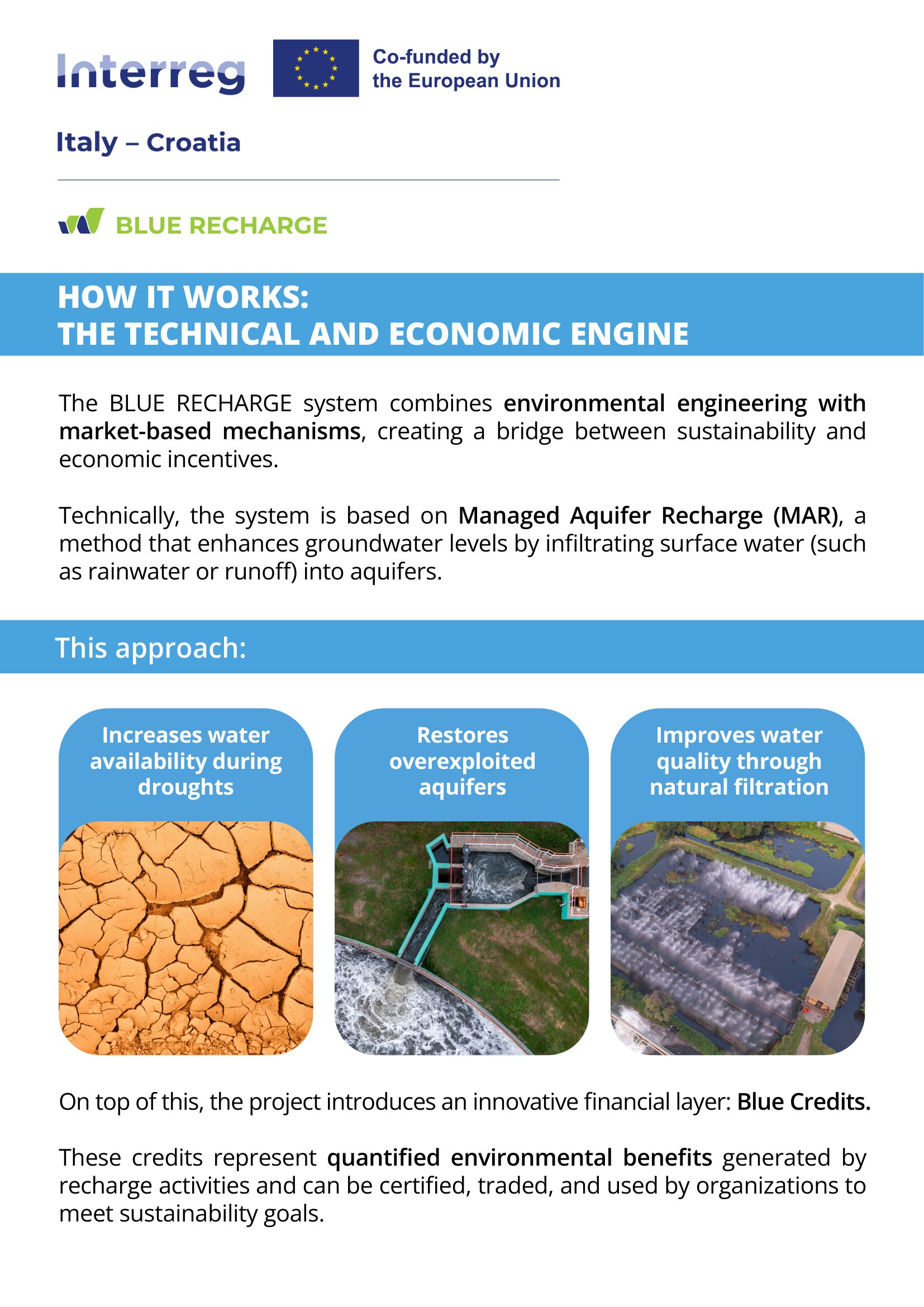
BLUE RECHARGE combines environmental engineering with market-based mechanisms, creating a bridge between sustainability goals and economic incentives. At its technical core is Managed Aquifer Recharge (MAR), a method that improves groundwater levels by infiltrating surface water such as rainwater or runoff into aquifers.
This approach delivers multiple benefits:
- Increased water availability during droughts
- Restoration of overexploited aquifers
- Improved water quality through natural filtration
Blue Credits: Turning Impact into Value
The project also introduces an innovative financial layer through Blue Credits. These credits represent quantified environmental benefits generated by recharge activities. They can be certified, traded, and used by organizations to support sustainability targets and ESG commitments.
To ensure trust and credibility, the system includes a strong Monitoring, Reporting and Verification (MRV) framework. Combined with a digital registry, potentially blockchain-based, it prevents double counting and guarantees the integrity of each credit.
A Structured Lifecycle
The BLUE RECHARGE model follows a clear process:
- Implementation of a MAR project
- Measurement of environmental benefits
- Certification and issuance of Blue Credits
- Registration on a digital platform
- Trading between buyers and sellers
- Continuous monitoring and verification
Who Can Benefit?
The system is designed for a broad ecosystem of stakeholders, including:
- Public authorities managing water resources
- Water utilities and basin authorities
- Private companies with ESG goals
- Farmers and landowners
- Certification bodies and auditors
- Investors and market intermediaries
By creating a shared responsibility model where environmental benefits are co-produced and co-financed across sectors, BLUE RECHARGE shows that water sustainability solutions can be modular, scalable, and economically viable for the future of Europe.