
Who we are
The Interreg Italy-Croatia Programme 2021-2027 is a European territorial cooperation programme supporting collaboration between Italian and Croatian regions across the Adriatic Sea. As a maritime Interreg programme, it places the Adriatic at the heart of cooperation, connecting territories, people, economies and communities on both sides of the basin.
The Programme covers 25 Italian provinces and 8 Croatian counties facing the Adriatic Sea and is now in its second programming period.
Building on the experience of 2014-2020, when almost 100 projects were funded, the 2021-2027 Programme continues to strengthen cross-border cooperation and address shared challenges and opportunities.
The cooperation area is characterised by a distinctive blue and green identity, combining the Adriatic Sea, coastal and marine environments, urban areas and inland territories.
Due to the central location of the Programme area, the Adriatic Sea represents a shared economic and environmental resource and a natural platform for strengthening cooperation between the two countries. This unique setting provides opportunities to develop joint solutions, strengthen blue and green innovation and build on the long-standing connections between the territories.
In particular, the Programme supports projects that strengthen blue and green innovation, capitalise on previous cooperation experiences and contribute to the implementation of the EUSAIR – the EU Strategy for the Adriatic and Ionian Region.
Discover our funding opportunities.
With around EUR 178 million of EU funding, the Programme provides opportunities for organisations in Italy and Croatia to work together, share knowledge and develop solutions to common challenges.
The Adriatic Sea is at the heart of the Italy-Croatia cooperation area and represents one of its greatest assets and drivers of development. From ports and maritime connectivity to marine biodiversity, blue industries and coastal tourism, the sea offers significant opportunities for sustainable growth and innovation across the border.
The Interreg Italy-Croatia Programme aims to unlock this potential by strengthening cooperation around a more innovative, sustainable and connected blue economy. Building on the experience and results of the 14-20 programming period, the Programme supports innovation, skills and knowledge exchange, strengthens links between research, businesses and public authorities, and encourages the development of new solutions for the blue sectors and sustainable tourism.
Sustainability is at the core of this approach. The Programme supports the protection of natural and cultural heritage, climate change adaptation, disaster risk prevention and the preservation of biodiversity. It also promotes more sustainable and resilient transport and mobility solutions, with a particular focus on improving cross-border maritime connectivity and intermodality.
Digitalisation and the circular economy are cross-cutting priorities, supporting the transformation of the Programme area across different sectors. Digital solutions and skills can improve competitiveness, connectivity and the valorisation of cultural and natural assets, while circular approaches can contribute to more efficient use of resources and more sustainable economic activities.
Overall, the Programme seeks to foster sustainable economic development, protect and valorise the shared natural and cultural heritage, improve cross-border connectivity and strengthen the capacity of institutions to work together and address common challenges.
The Programme is structured around five Priorities supporting seven Specific Objectives, aimed at promoting innovation and competitiveness, protecting the environment and adapting to climate change, improving sustainable mobility, enhancing culture and tourism, and strengthening institutional cooperation and governance.
Digitalisation, youth engagement and capitalisation are cross-cutting dimensions of the Programme, supporting cooperation across priorities and helping to ensure that knowledge, solutions and results are shared, reused and built upon.
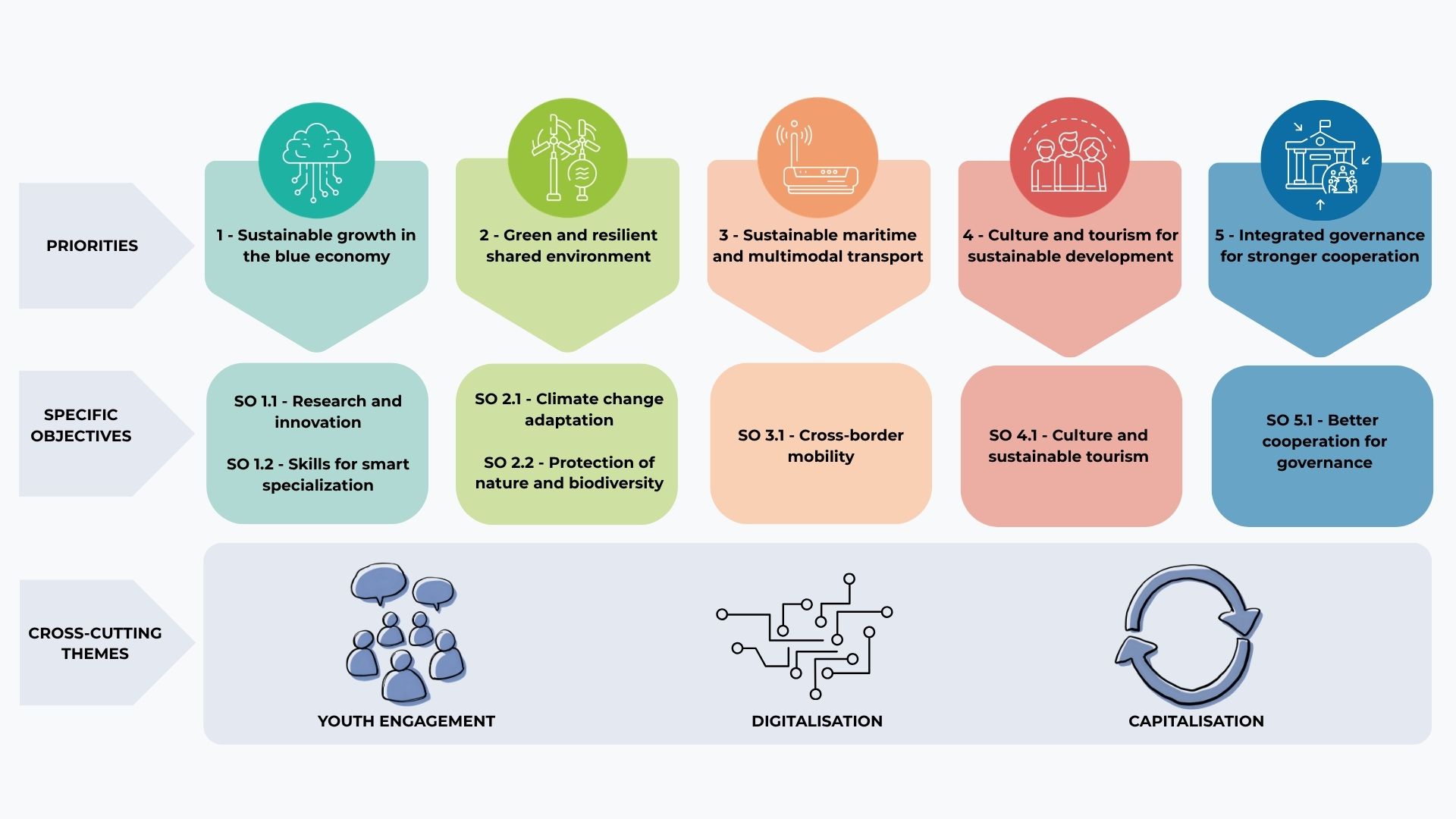
PRIORITY 1 - Sustainable growth in the blue economy
- SO 1.1 - Research and innovation
The Programme aims to strengthen research and innovation capacities across the Italy-Croatia area, with a particular focus on the blue economy.
It supports applied research, technology transfer and stronger cooperation between research institutions, businesses, public authorities and other innovation actors. Actions also promote access to advanced technologies for SMEs, cross-border innovation ecosystems and the mobility of researchers.
- SO 1.2 - Skills for smart specialization
The Programme aims to strengthen the innovation and internationalisation capacity of SMEs, particularly in blue economy sectors, while developing the skills needed for smart specialisation and the green and digital transition.
It supports entrepreneurial and digital skills, cross-border knowledge hubs, training and mutual learning, as well as initiatives helping SMEs access new markets and opportunities.
PRIORITY 2 - Green and resilient shared environment
- SO 2.1 - Climate change adaptation
The Programme aims to improve the capacity of the two countries to monitor, anticipate and respond to climate-related and other natural or human-made risks.
It supports shared data and monitoring systems, common approaches to climate adaptation, risk prevention tools, early warning systems and joint emergency and rescue planning, while also raising awareness and strengthening the resilience of natural and cultural heritage.
- SO 2.2 - Protection of nature and biodiversity
The Programme aims to strengthen the protection and preservation of biodiversity, ecosystems and green infrastructure while reducing pollution across the shared territory and the Adriatic Sea.
It supports joint monitoring and data systems, integrated management of marine and coastal resources, biodiversity protection, awareness and education, and innovative solutions to prevent and reduce pollution.
PRIORITY 3 - Sustainable maritime and multimodal transport
- SO 3.1 - Cross-border mobility
The Programme aims to improve cross-border connectivity by making maritime and multimodal transport greener, smarter, safer and better integrated with local and regional transport networks.
It supports sustainable port infrastructure and technologies, better connections between ports and hinterland areas, digital solutions, alternative fuels, improved passenger and freight mobility, and new cross-border maritime and intermodal services.
PRIORITY 4 - Culture and tourism for sustainable development
- SO 4.1 - Culture and sustainable tourism
The Programme aims to make tourism more sustainable, inclusive and resilient by diversifying tourist flows, strengthening destinations beyond the main coastal areas and improving access to cultural heritage.
It supports sustainable destination management, digital and innovative tourism solutions, cross-border routes and thematic networks, the valorisation and digitalisation of cultural heritage, and the development of green and digital skills and more resilient jobs in the sector.
PRIORITY 5 - Integrated governance for stronger cooperation
- SO 5.1 - Better cooperation for governance
The Programme aims to strengthen the ability of institutions and stakeholders to work across borders, addressing legal and administrative obstacles and building stronger capacities for cooperation and multi-level governance.
It supports joint actions to identify and reduce cross-border barriers, capacity building, governance models, improved communication and data sharing, and better cross-border public services.
When was the 2021-2027 Programme approved?
The programming process for the 2021-2027 period started at the end of 2020 and led to the approval of the Interreg Italy-Croatia Programme by the European Commission in August 2022.
The Programme cycle
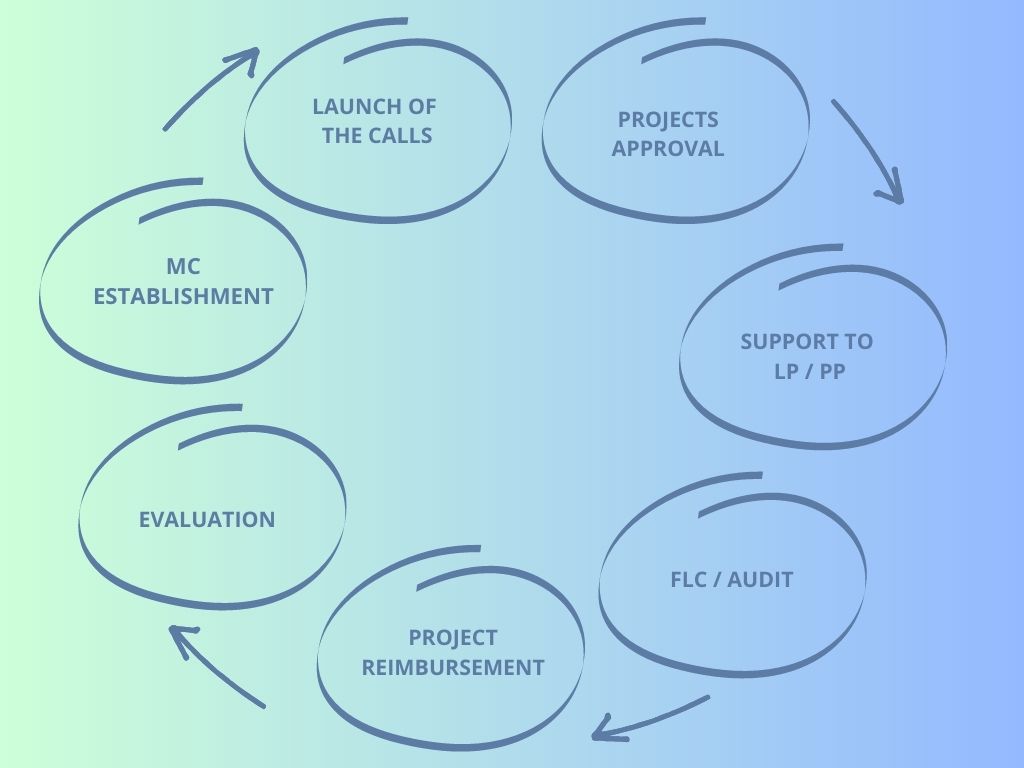
Since then, the Programme has moved through a continuous cycle of calls for proposals, project selection, implementation, monitoring and evaluation, with the Managing Authority, the Joint Secretariat and the Monitoring Committee working together to ensure the effective delivery of the Programme.
The Monitoring Committee, supported by the Managing Authority and the Joint Secretariat, oversees the implementation of the Programme and decides on the timing and scope of calls for proposals, in line with the Programme's priorities, objectives, target groups and available resources.
Through the calls for proposals, EU funding is allocated to cooperation projects. Applications are assessed on the basis of eligibility and quality criteria approved by the Monitoring Committee, and the highest-ranked proposals are selected for funding according to the resources available.
Once projects are approved, they enter the implementation phase. The Joint Secretariat supports beneficiaries throughout the project cycle, while project progress and expenditure are regularly monitored and reported. The Programme uses JEMS as its digital monitoring system, providing a shared repository of information and data on both Programme and project implementation.
Monitoring and evaluation activities help assess whether the Programme is delivering the expected results and identify any issues requiring action. Where necessary, the Programme can be adjusted or reprogrammed, subject to the relevant approval procedures.
The cycle concludes with the assessment of the results achieved by the Programme and its projects. The Final Performance Report, to be submitted by 15 February 2031, will provide the final assessment of implementation and achievements during the 2021-2027 programming period.
How does project funding work?
During implementation, the Lead Project Partner coordinates the reporting process, collecting progress information and expenditure data from all project partners. Expenditure is checked and validated by the First Level Controllers (FLCs) before being included in the project report submitted to the Joint Secretariat.
Once the reported expenditure has been verified and accepted, the Managing Authority reimburses the eligible expenditure to the project. On the basis of the expenditure recognised and reimbursed, the Managing Authority then submits applications for payment to the European Commission.
Programming Process
The programming process for this new cycle started at the end of 2020 and it ended with the approval of the Programme in August 2022
Programming is a long and complex negotiation process among many actors (not only institutional), who collaborate in drafting the Programme to foster cooperation between Italy and Croatia by promotion an integrated and harmonious regional development.
A Task Force, composed of national and regional authorities of the two Member States, as well as the representatives of the programme partnership, was set up at Programme level in order to lead the programming process.
The process started with the definition of the Territorial Socio-Economic Analysis (TSEA), where strengths and weaknesses of the territory, as well as threats and opportunities, were highlighted.
The analysis was able to identify the list of the main needs of the area and the related challenges that the Programme had to face. The involvement of the Stakeholders for a careful and complete evaluation was essential and, for this purpose, specific consultations had been carried out. On the basis of the TSEA results and the Stakeholders’ consultations feedback, the TF continued to work on with the new Programme, providing subsequent updated versions of it.
Before the final version, the Programme underwent a Strategic Environmental Assessment (SEA); thereby everyone could participate in the consultation focused on the potential environmental effects of the Programme.
At the end of the process, the TF approved the final draft of the Interreg Programme (IP) and the Managing Authority submitted the document to the European Commission. Then the formal negotiations took place leading, finally, to the approval of the Programme with a decision of the European Commission.
The Interreg VI A Italy-Croatia 2021-2027 Programme has been drafted filling in the Interreg Programme (IP) template included in the Interreg Regulation 1059/2021.
The IP template was divided into seven chapters:
- Programme strategy (1.1 Programme area; 1.2 Summary of main joint challenges, joint investment needs and complimentary and synergies with other forms of support, lessons-learnt from past experience and MRS; 1.3 Justification for the selection of POs, SOs and the ISOs)
- Priorities (2.1.1 Specific Objectives (repeated for each SO); Related types of action and their expected contribution to SOs and to MRS; Indicators; Main target groups; Indication of the specific territories targeted; Planned use of financial instruments; Indicative breakdown by type of intervention)
- Financing plan (3.1 Financial appropriations by year; 3.2 Total financial appropriations by fund and national co-financing)
- Action taken to involve the relevant programme partners in the preparation of the Interreg programme and the role of those programme partners in the implementation, monitoring and evaluation
- Approach to communication and visibility for the Interreg programme
- Implementing provisions (6.1 Programme authorities; 6.2 Procedure for setting up the joint secretariat; 6.3 Apportionment of liabilities among participating MSs and where applicable, the third countries and OCTs, in the event of financial corrections imposed by the MA or the EC)
- Use of unit costs, lump sums, flat rates and financing not linked to costs.
In order to strongly support the TF on the drafting of the thematic contents of the Programme, two external service providers were selected for the elaboration of the Territorial and Socio Economic Analysis and for the preparation of the first draft of IP thematic chapters.
Territorial and Socio Economic Analysis (TSEA)
The Territorial and Socio-Economical Analysis Report had been elaborated in order to provide the necessary knowledge base for starting the process of drafting the next Italy-Croatia Cross-Border Cooperation Programme 2021-2027. The core of the document was the SWOT analysis, which summarized the results of the analysis in all domains and presented them under the well-known articulation of Strengths, Weaknesses, Opportunities and Threats. Finally, an analysis of the key challenges for the development of the cross-border area was proposed, in which 31 challenges had been extracted from the SWOT and proposed for the future steps of the elaboration of the new Programme.
Territorial and Socio Economic Analysis Report
Thematic Scenarios Starting from the TSEA
Report and further elaborating a multicriteria analysis, the evaluator identified 6 simulated territorial and thematic scenarios, as possible and technically grounded set of choices for the drafting of the new Programme: which intervention, for which territories/target group/sector, pursuing which objectives.
Costumized Scenario
Taking into account the Task Force’s inputs, a final customized scenario was elaborated by the evaluator and approved by the Task Force. Its vision could be expressed as follows: “focusing on the blue economy and maritime related challenges, in continuity with the 2014-2020 Programme and in consistency with EUSAIR pillars”.
Together with the scenario 12, related challenges had been identified and the following 6 Specific Objectives had been selected:
- 1.1 Innovation and research
- 1.4 Smart specialization
- 2.4 Climate change adaptation and environmental risk prevention
- 2.7 Protection of biodiversity and reduction of pollution
- 3.2 National, Regional, local and cross border mobility
- 4.6 Culture and sustainable tourism
The Task Force decided to also include the Interreg Specific Objective 1 – Better Cooperation Governance (“ISO 1”) and consider digitalization and circular economy as cross-cutting priorities for tackling all the challenges.
Intervention Logic
The intervention logic was defined by the IP drafter and submitted to the Task Force.
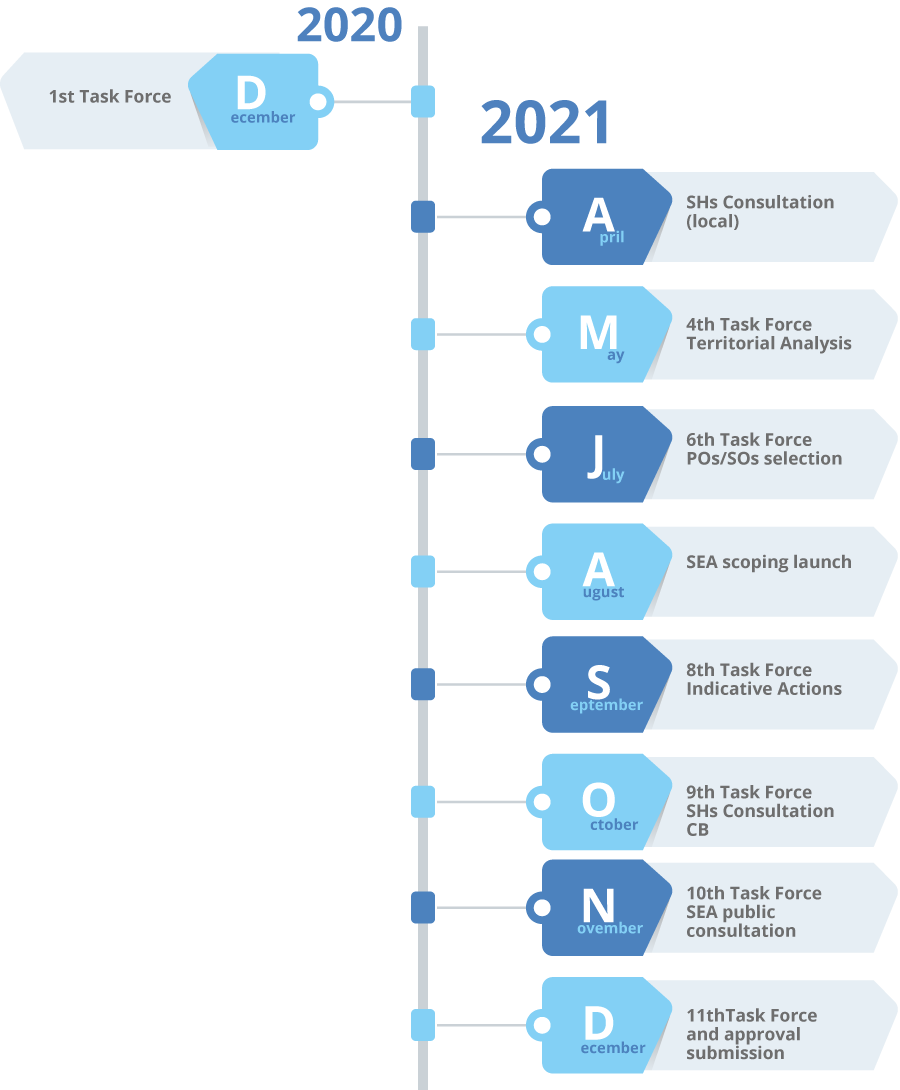
In autumn 2020, Member States’ agreed on the Task Force composition and the first TF meeting was scheduled for December 2nd.
Internal rules of the Task Force (Rules of Procedure – RoP) were defined regarding the composition and chairmanship, the functions, the meetings and working groups organisation, the decision making process and the written procedures.
The Managing Authority and Joint Secretariat of the current Programme supported the Task Force.
2021
11th MEETING – 15th DECEMBER 2021 online
10th MEETING – 11th NOVEMBER 2021 online
9th MEETING – 14th OCTOBER 2021 online
8th Meeting – 14th September 2021 - Online meeting
7th MEETING – 28th JULY 2021 online
6th MEETING – 2nd JULY 2021 online
5th MEETING – 17th JUNE 2021 online
4th MEETING – 18th MAY 2021 online
3rd MEETING – 17th MARCH 2021 online
2nd MEETING – 18th FEBRUARY 2021
2020
ENVIRONMENTAL CONSULTATION
In compliance with Directive 2001/42/EC (SEA Directive), the Managing Authority had implementied a Strategic Environmental Assessment (SEA) to assess the likely effects of the Interreg VI A Italy-Croatia 2021/2027 Programme on the environment.
The Programme elaborated the environmental report, prepared with an external evaluator support and with the participation of the relevant environmental authorities, both Italian and Croatian.
In order to keep the participation simple, a non-technical summary was available, containing the most relevant information. Anyone could take part into the consultation, sending observations and comment to the Managing Authority, both on the environmental report and on the draft of the Interreg Programme. The documents are available hereinafter:
- Draft Interreg VI A Italy-Croatia 2021/2027 Programme
- Environmental report
- Non-technical summary
- Consultation Announcement
- SEA documentation (zip file, in Italian language)
The consultation remained open from the 30th November 2021 until the 14th January 2022
STAKEHOLDER INVOLVEMENT
In order to ensure the involvement of the Programme partnership in accordance with the European Code of Conduct on Partnership (EU Regulation n. 240/2014), the Programme Task Force approved a Plan for the effective involvement and consultation process of the economic and social partners in the programming phase (first meeting of 2nd December 2020).
The Plan established to hold the consultations for the Italy-Croatia 2021-2027 Programming period in two different moments and at two different levels, as described below:
- Local consultation: one on the Italian and one on the Croatian territory (for restricted stakeholders lists)
- Cross-border consultation: to be launched when a position of the TF on the main policy/specific objectives is made (open to all stakeholders)
CROSS-BORDE INVOLVEMENT
SURVEY
The first step of the second round of consultations consisted in a survey addressed to the wider public - all Programme stakeholders. The survey, launched on 25th September and closed on 8th October 2021, collected all the inputs coming from both the previous local consultation and the TF’s decisions. The main aims of this survey were:
- to know and collect the stakeholders’ opinion on the priority strategies and Policy and Specific objectives that had been identified by the TF
- to collect input to define the actions and related target groups that will be implemented through the 2021-2027 Programme.
In total 166 stakeholders participated in the online survey: 94 from Italy and 74 from Croatia.
WEBINAR
The second step of the second round of consultations was conceived as a Cross-border consultation webinar organized online on 21th October 2021 and opened to all Programme stakeholders.
The purpose of the webinar was to describe the 2021-2027 programming & consultation process, providing an overview of the POs and SOs selected by the TF and presenting the Intervention Logic followed to identify the examples of actions, as well as to analyse and discuss togetherwith the stakeholders the answers collected through the on-line survey, with a particular focus on each thematic priority.
The engagement of the participants was ensured by means of the live questions & answers and in the form of polls in order to collect suggestions for the fine-tuning of the 2021-2027 Programme, before its submission to the European Commission.
The webinar was attended by 220 participants: 78 stakeholders from Croatia, 141 from Italy and 1 from Albania.
Please find here below all the useful materials from the webinar.
Presentations
- Presentation of the 2021-2027 programming & consultation process
- General overview of the 2021-2027 Programme strategy
- Presentation of the answers collected through the on-line survey (Parts 1 & 2)
- Workshop - PO1 and PO2 - Definition of Actions
- Workshop - PO3 and PO4 - Definition of Actions
- Presentation of the answers collected through the on-line survey (Part 3 for POs 1,2,3,4)
- IP drafting - next steps
VIDEO RECORDING
See video here
REPORT OF RESULTS
The results of the on line questionnaire and the answers of the stakeholders to the polls launched during the webinar, had been extensively analysed by the MA and JS. They were subsequently submitted and discussed with the 2021-2027 Task Force, with a particular focus on the impact on the IP content and its fine-tuning.
In the overall report of the Cross-Border Consultation – Analysis of results it is possible to find a synthesis of all collected inputs and suggestions gathered from all the stakeholders involved, together with accompanying explanations on the modalities for their integration done by the Programme during the IP fine-tuning phase.
LOCAL CONSULTATION
The first round of consultations started with two webinars organized online for Croatian and Italian stakeholders, on 15th and 16th April 2021, previously consulted via an online survey.
The consultations were organized according to the same shared methodology, but the language was adapted to the needs of the local stakeholders invited by the Programme on behalf of the Task Force 21-27, thus Croatian and Italian were used respectively in order to guarantee the full understanding and acknowledgement of the overall content.
Almost 200 participants joined actively the webinars: 70 stakeholders on the Croatian side and 120 on the Italian side had been engaged in the online webinar.
Poll voting was used to express stakeholder's opinion and provide inputs that have constituted the starting point in better shaping the new Programme 2021-2027, all around Programme's stakeholders needs. Please find out more from the presentations available to all stakeholders and about the results that came out from the live polling here below.
15th April 2021
CROATIAN CONSULTATION WEBINAR - PRESENTATIONS
- Makro područje A – Analiza potreba teritorija Programa na domenama intervencije koje su već obuhvaćene Programom prekogranične suradnje Italija-Hrvatska za razdoblje 2014.-2020
- Makro područje B – Ciljevi i ključni prioriteti u nacrtu EU propisa za razdoblje 2021.-2027.
- Makro područje C – Projekti EUSAIR Flagship
- Makro područje D – Inovacije u postupcima, vrste poziva
CROATIAN CONSULTATION WEBINAR - VIDEO
16th April 2021
ITALIAN CONSULTATION WEBINAR - PRESENTATIONS
- Macro area A – Analisi dei bisogni del territorio del Programma sui settori di intervento già coperti dal Programma Interreg Italia-Croazia 2014-2020
- Macro area B – Obiettivi e priorità chiave delle proposte di Regolamento per il periodo 2021-2027
- Macro area C – Azioni EUSAIR Flagship
- Macro area D – Innovazione nelle procedure e tipi di bandi
ITALIAN CONSULTATION WEBINAR - VIDEO
31st May 2021
STAKEHOLDERS' CONSULTATIONS: ANALYSIS & PRESENTATION OF THE RESULTS
The current document - Stakeholders' Consultations 21- 27 - presents an in-depth analysis and presentation of the stakeholders' needs and inputs received during the live poll organized in occasion of the 2 webinars with Croatian and Italian local stakeholders. It is possible to read the aggregated data results, as well as the entries from the Croatian and Italian stakeholders.
The different colours used in the infographics facilitate the comprehension and data reading.
In compliance with Directive 2001/42/EC (the SEA Directive), the Programme should implemented the Strategic Environmental Assessment (SEA), to be conducted to assess the effects of certain plans and programmes on the environment.
The Strategic Environmental Assessment was foreseen in parallel with the definition of the Programme’s strategy and main elements. It is an interactive process that provides the Programme drafting teams an external view, guidance and recommendations. Indeed, the SEA provides relevant information to assess the environmental challenges and considerations which ensure that the environmental concerns are appropriately integrated in the decision making and implementation process of the Programme.
The main steps in the SEA process were the following:
1. SCOPING PHASE
The scoping phase aimed to determine the scope and the level of detail of information to be included in the Environmental Report. From the 13th August to the 12th September, the Environmental Authorities of the Programme area were consulted within the scoping process, on the basis of two preliminary documents:
The observations received, collected in the final scoping report, were taken into consideration in the environmental report.
2. ENVIRONMENTAL REPORT
The environmental report contained the likely significant effects on the environment of implementing the Programme and reasonable alternatives taking into account the objectives and the geographical scope of the Programme.
3. CONSULTATION
The authorities with specific environmental responsibilities and the general public were given an early and effective opportunity to express their opinion on the draft Interreg Programme and the accompanying environmental report.
To this purpose, a public consultation remained open from 30th November 2021 to 14th January 2022.
4. CONSULTATION FOLLOW-UP
Inputs which emerged from the SEA consultation were collected in a unique document, available here.
5. INFORMATION ON THE DECISION
As required by Art. 55(4) Regulation (UE) No 1303/2013 and defined by the Directive 2001/42/EC, here is published the Strategic Environmental Assessment (SEA) Statement.

