Breadcrumb

Subpage 3

Lifelong Learning for Climate Resilience: Turning Project Knowledge into Practice

Lifelong Learning for Climate Resilience: Turning Project Knowledge into Practice

CRESCO Adria connects higher education, professional training and local knowledge to strengthen climate adaptation capacities across the Adriatic.
Climate change adaptation requires more than technical analyses and planning documents. It also requires people with the right knowledge, skills and tools to understand environmental change, assess risks and design practical responses. This is why lifelong learning is an important part of the CRESCO Adria project.
Through Work Package 2, the project supports the development of training and educational activities that connect climate science, spatial planning, risk management, economics, governance and local adaptation practice. The aim is to ensure that the knowledge created within the project is transferred to students, professionals, public authorities and local stakeholders who will continue working on climate resilience beyond the project lifetime.
 

Accredited lifelong learning at EFRI

Accredited lifelong learning at EFRI

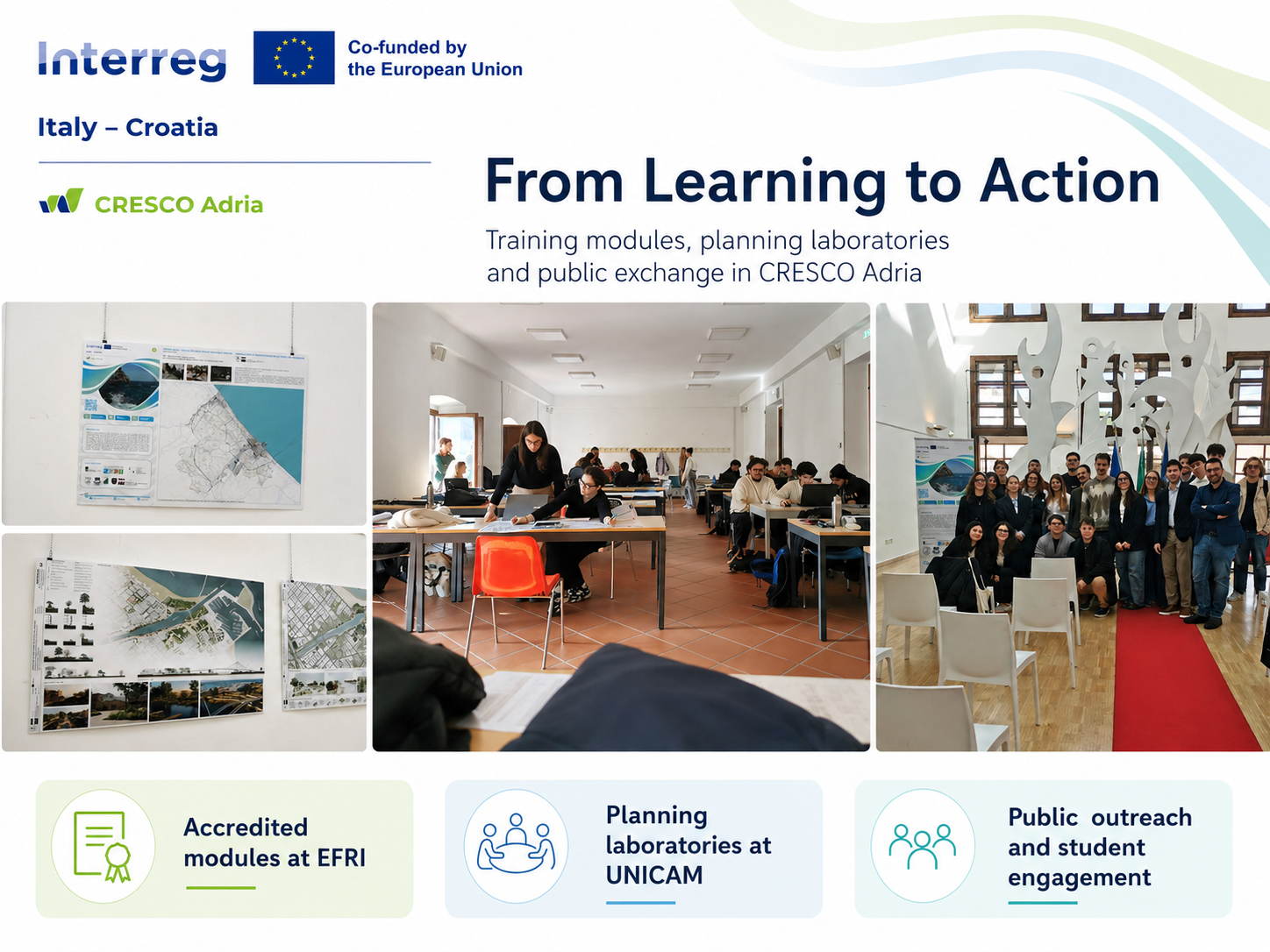
At the University of Rijeka, Faculty of Economics and Business (EFRI), the micro-qualification Recognizing Environmental Changes and Risk Management moved from internal approval to full accreditation. The programme is scheduled to start in March 2026 and represents an important step in embedding CRESCO Adria topics into structured lifelong learning.
The first set of accredited modules includes Data Processing Methods in Natural and Social Sciences, Extreme Natural and Social Events, and Managing the Commons. Together, these modules provide an interdisciplinary curriculum that combines economics, environmental science, statistics, governance and risk management.
The programme is designed for students, professionals and local stakeholders working on climate adaptation, environmental management and risk-related decision-making. It is structured in a hybrid format, combining classroom teaching with e-learning tools, in order to increase accessibility and support participation from different target groups.
EFRI is also working on expanding the programme towards 30 ECTS, strengthening its long-term relevance and compatibility with regional and cross-border educational frameworks.

UNICAM laboratories: learning through the Nuova Pescara pilot area

UNICAM laboratories: learning through the Nuova Pescara pilot area

The University of Camerino (UNICAM) continued to integrate CRESCO Adria themes into its educational activities through the Master’s course Methods and Tools for the Green and Digital Transition of Territories, as well as through activities within the Master’s Degree in Architecture and the Level II Master’s programme.
A key contribution was the implementation of City and Landscape Planning Laboratories A and B, held from September 2025 to January 2026 and involving around 30 students. The laboratories focused on the Pescara Urban Area, allowing students to work directly with themes relevant to CRESCO Adria: climate adaptation, coastal and urban risk reduction, resilient urban design, Nature-Based Solutions, blue-green infrastructure, governance tools and Adriatic territorial dynamics.
Students developed analytical and design frameworks for the Nuova Pescara pilot area, linking scientific knowledge, planning tools and local data with practical design proposals. This approach strengthened the connection between project research outputs and higher education, while also creating a space for students to explore how climate adaptation can be translated into urban and territorial planning.
The activity concluded with a public exhibition at AURUM in Pescara, held from 24 to 26 February 2026, where student proposals were presented to local stakeholders. This created an important moment of knowledge exchange between students, researchers, planners and local actors, and further connected the educational process with stakeholder engagement in the pilot area.

GRADRI: integrating adaptation into teaching and public outreach

GRADRI: integrating adaptation into teaching and public outreach

The University of Rijeka, Faculty of Civil Engineering (GRADRI) also contributes to lifelong learning and knowledge transfer by integrating CRESCO Adria topics into teaching and public-facing activities.
GRADRI decided to include project themes in a course focused on buildings and public spaces, where students work on adaptation scenarios related to climate extremes. This allows students to connect climate risk knowledge with practical questions of built environment adaptation, resilient public space design and climate-sensitive planning.
In addition, GRADRI contributed to information exchange by presenting CRESCO Adria and its results to the wider public during Researchers’ Night – Blue-connect 2.0 on 26 September 2025. Through posters and visual materials, the project’s themes were communicated to a broader audience, helping raise awareness about climate risks, spatial planning and adaptation in coastal areas.
 

From learning to implementation

From learning to implementation

Together, the activities implemented by EFRI, UNICAM and GRADRI show how CRESCO Adria transforms project knowledge into practical educational formats. The project does not treat training as a separate activity, but as a bridge between research, planning and implementation.
Scientific outputs from Work Package 1 and stakeholder-oriented activities from Work Package 3 are gradually being translated into accredited modules, laboratories, teaching materials, public exhibitions and student work. This creates a broader learning ecosystem in which climate adaptation is approached from multiple perspectives: data, risk, governance, spatial planning, architecture, local knowledge and community needs.
By connecting universities, students, professionals and local stakeholders, CRESCO Adria strengthens the foundations for long-term climate resilience in the Adriatic area. The project’s lifelong learning activities ensure that climate adaptation knowledge remains active, transferable and useful after the project ends.

Our contact form is open for all your requests