
One model, many shores: how we built our training programs
23/11/2026
BIOPRESSADRIA is nearing its end. After more than thirty months of joint work between Italian and Croatian partners, the project is publishing its reports. What we have learned about the pressures on marine and coastal habitats, and about the solutions that can counter them, is being brought together into a toolbox. Its purpose is to let others replicate these solutions and tackle biodiversity loss across the Adriatic, the Ionian and the wider Mediterranean.
At the end of October we published two project documents: ‘The Protocol definition for monitoring beach and leisure boating tourism pressures in pilot areas’ explained how the project measures. ‘The Report on characterization of habitat quality and pressures in pilot areas’ showed what it found: the condition of seagrass meadows, boat pressure, anchoring damage, dune trampling. Today we're focusing on the importance of the training programs we launched within the project to take a closer look at one of BIOPRESSADRIA's activities. Knowing where and how much tourism weighs on coastal habitats is not enough if the people who manage the coast cannot act on it. That is why, between November 2025 and May 2026, BIOPRESSADRIA ran a series of trainings in Italy and Croatia. The document we publish today, ‘Training Programs’, coordinated by CORILA with all partners, presents their structure: how the trainings were designed, what they cover and who they are for. A second document, the ‘Training Programs Report’, coming soon, will tell how the trainings went and how many stakeholders took part.
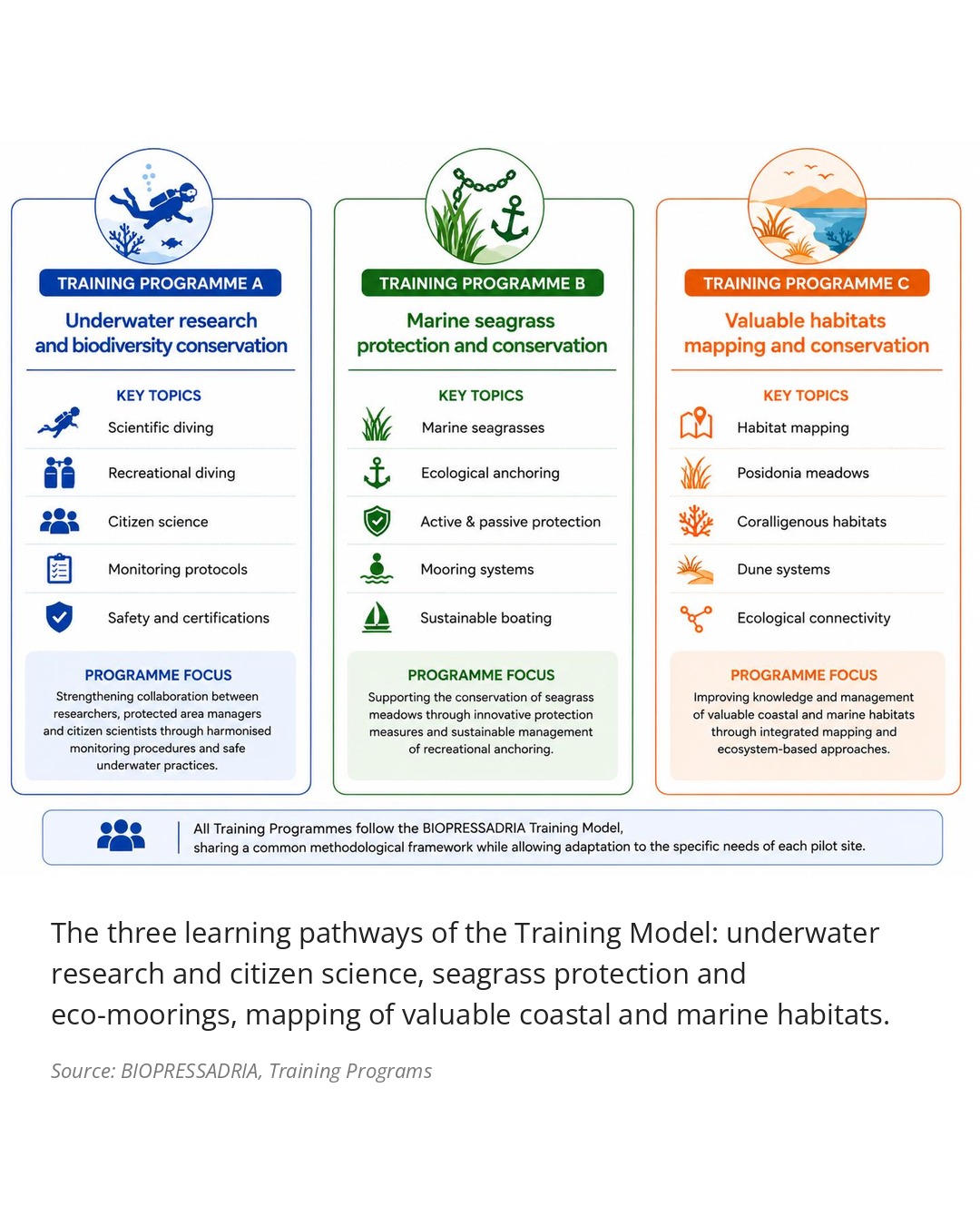
The training was not decided at the drawing board. Partners started from a broad list of possible topics, from habitat mapping to eco-moorings, scientific diving and citizen science. They then refined the list in technical meetings and checked it with local stakeholders at each pilot site. The topics follow closely what monitoring revealed at sea and on the beach: anchoring scars in the meadows, the pressure of thousands of boats, dunes worn down by trampling. The result is a shared Training Model: a common backbone of 16 hours over at least two days, mixing lectures, workshops, case studies, field activities and even role-playing games. Each site can build on this backbone with its own modules, field trips and local examples.
From this model come three learning pathways. The first looks at how recreational divers, scientific divers and ordinary citizens can help monitor marine life and collect reliable data, safely and to recognised standards. These are the same skills the scientific divers used to apply the SCARS protocol and measure anchoring damage in the meadows. The second focuses on seagrass meadows and the systems that protect them, especially ecological moorings that let boats stop without tearing up the seabed. This is the core of the project's pilot actions: the new eco-mooring buoys in Kornati, the renewed buoy field in Panzano Bay and the feasibility study for a new eco-mooring field in the Pakleni Islands. The third teaches how to map and read valuable habitats such as Posidonia meadows, coralligenous reefs and dunes as one connected system, using satellites, remote sensing and field surveys. These tools are the ones behind the satellite counts of boats and the drone surveys of the dunes, and they support the coastal restoration work in Porto Cesareo.
The document also shows how each pilot site shaped the model to its own needs. At Porto Cesareo Marine Protected Area it became an eight-day course combining classroom and field work. Panzano Bay in Monfalcone hosted a two-day international training on biodiversity, ecosystem services and eco-anchoring. In Croatia, SUNCE organised two trainings. One, held with the protected areas of Dubrovnik-Neretva County, covered sustainable nautical anchorages and featured experiences from Porto Cesareo and Kornati. It came at the right time: in the waters around Badija and Korčula, satellite monitoring had shown how many boats drop anchor directly on Posidonia. The other invited citizens to become "observers of the Adriatic", including keeping watch for the invasive lionfish.
Method first, then data, then results, and finally people able to use them: the trainings close the circle opened by the monitoring protocol. Because it is flexible by design, the model can be reused by other protected areas and future projects. This way, what BIOPRESSADRIA has learned can keep spreading along the Adriatic after the project ends.