

Two Kilometres apart, two different fates
29/10/2026
BIOPRESSADRIA is nearing its end. After more than thirty months of joint work between Italian and Croatian partners, the project is publishing its reports. What we have learned about the pressures on marine and coastal habitats, and about the solutions that can counter them, is being brought together into a toolbox. Its purpose is to let others replicate these solutions and tackle biodiversity loss across the Adriatic, the Ionian and the wider Mediterranean.
One of these reports, "Characterization of habitat quality and pressures in pilot areas", is now available on the project website. Coordinated by our project partner Sunce, it presents field data from five pilot sites: Panzano Bay (Monfalcone), Porto Cesareo MPA, Kornati National Park, the Pakleni Islands and the Natura 2000 sites around Badija, in Dubrovnik-Neretva County. Satellite vessel detection, drones, sonar, scientific diving and bioacoustics were applied with shared protocols, so results can be compared across the border.
Some findings are encouraging. In Panzano Bay, seagrass meadows show only localised anchor scars and a strong capacity to recover, and the eco-mooring field supports substantial fish biomass. In Kornati, a new buoy field in a deeper bay acted as a fish-aggregating structure: fish density rose more than six-fold, from about 10,800 to over 66,000 fish per hectare.
Others are a warning. In the Pakleni Islands, vessel numbers grew by 9% between 2023 and 2025, and yachts over 24 m now reach almost every bay. In Soline–Prevojice, nearly 85% of anchored boats sit directly on *Posidonia oceanica* meadows.
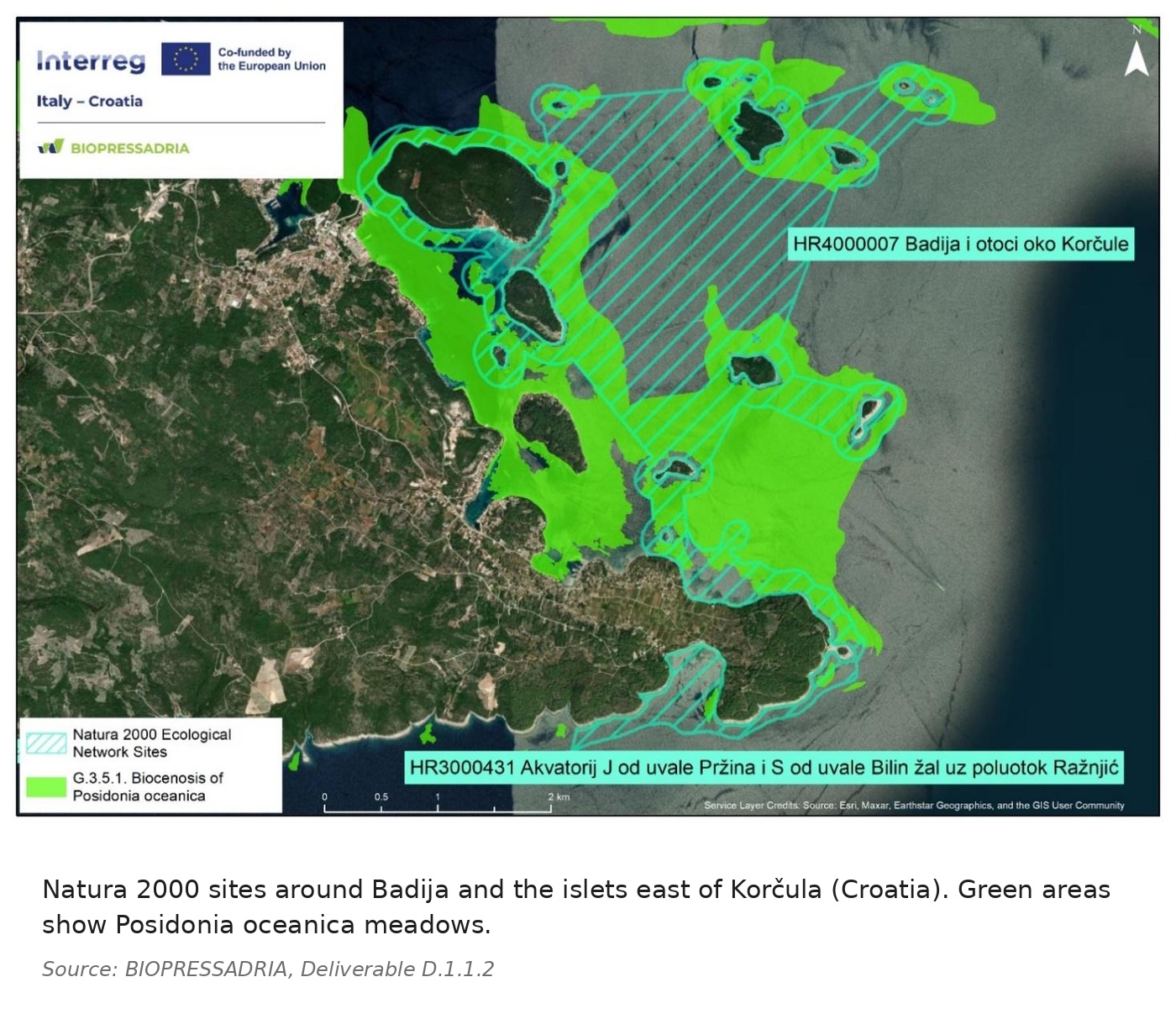
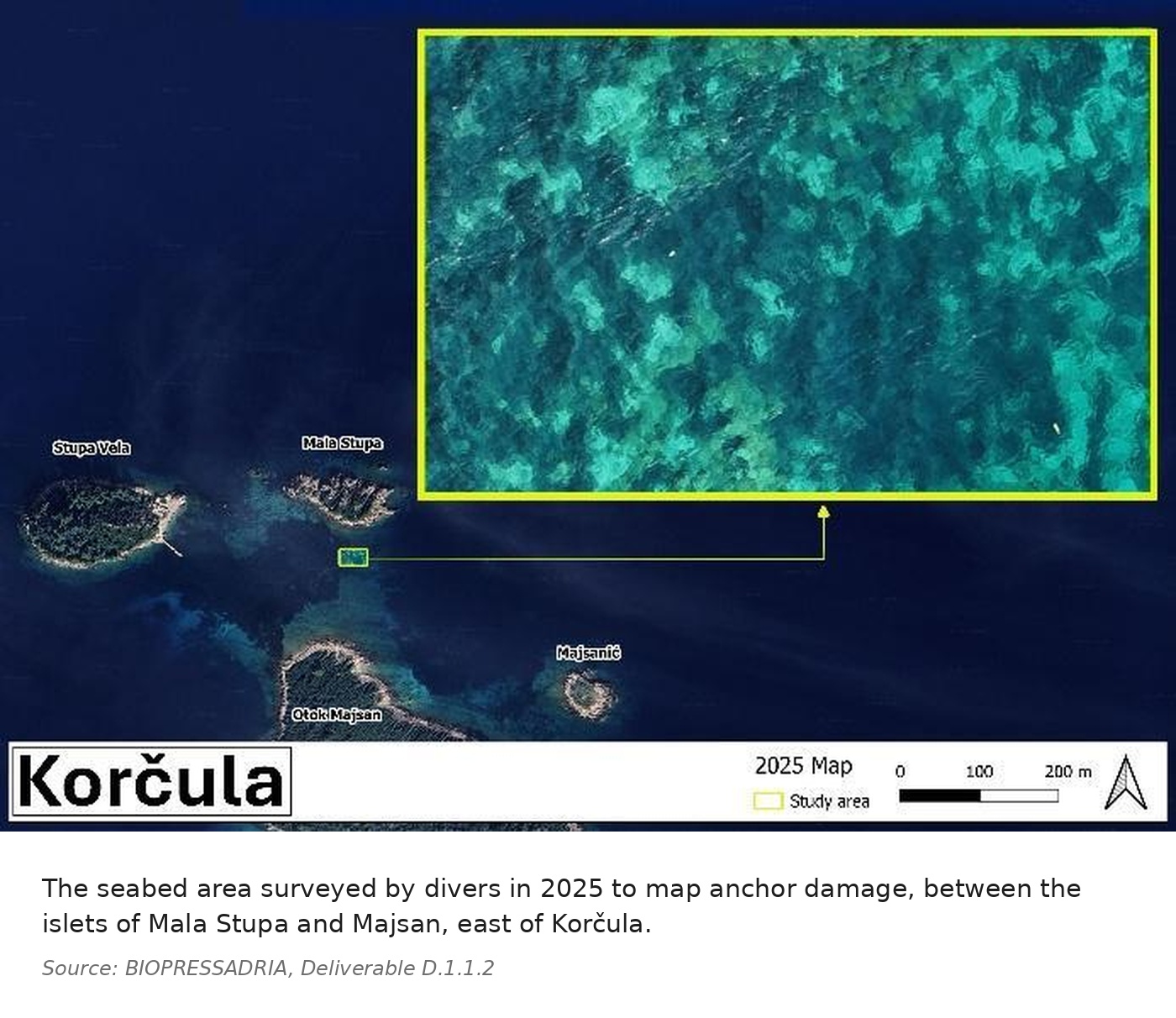
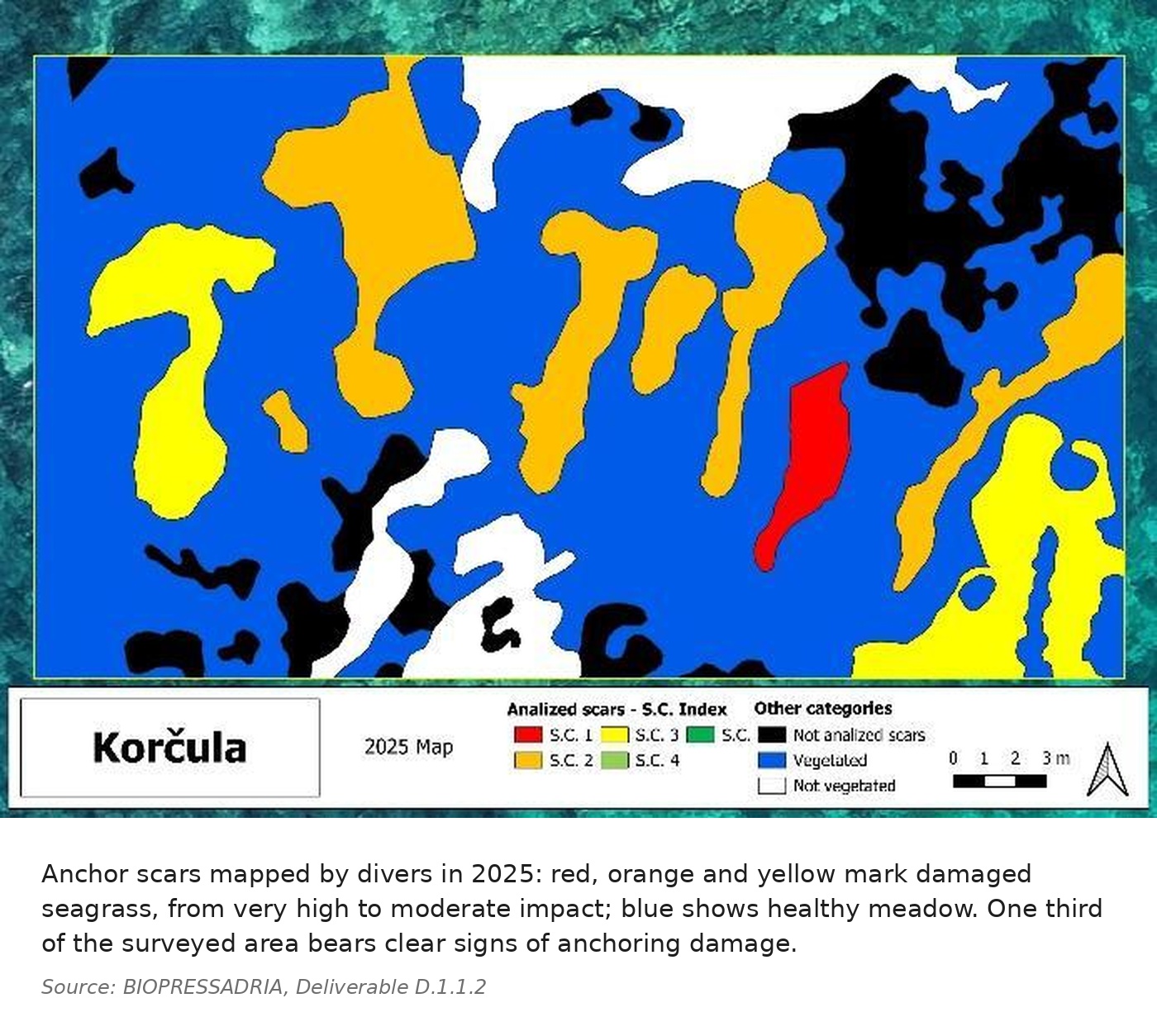
In the Badija area, near Korčula, the share of anchored vessels sitting on Posidonia rose from 33% in 2023 to 46.5% in 2025, and at Badija itself dead matte now covers about 60% of the seabed. Just 2 km away lies Majsan, where anchoring is almost absent, and its meadow is thriving: 312 shoots per square metre, against only 90 at Badija. If general environmental factors such as water temperature or pollution were to blame, Majsan would be suffering too. It is not, and the report concludes that anchoring is the main driver of decline. Between the two lies Mala Stupa, monitored for the first time in 2025. Its meadow is already under stress as anchoring grows, and it is the place where acting now could still prevent further loss. The images below show the stretch of seabed near Mala Stupa where divers mapped anchor scars in 2025. The report also records the first Croatian sighting of the invasive seagrass *Halophila stipulacea*, found at Badija.
In Porto Cesareo, a beach carrying-capacity analysis and an environmental accounting of the protected area show how visitor flows can be managed while still protecting dunes and Posidonia beds. Two annexes complete the report: one presents a 3D "digital twin" approach to measuring anchor damage, the other a survey of 177 stakeholders, many of whom say they are ready to use designated moorings.
Download the full report on characterization of habitat quality and pressures in pilot areas , with maps, data and site-by-site recommendations, from the Library section of the BIOPRESSADRIA website (at the link you find on the right side of this page). Together, these results form the baseline against which the project's eco-moorings, zoning and visitor management measures will be measured.
The final conference is approaching: Venice, 10–11 November 2026. If you have not done so yet, keep reading our articles, register and join us in person to hear what we have achieved over more than thirty months of working side by side!