

Venice Lagoon: from spaces to gobies.
27/10/2026
A vaporetto, a fishing boat, a yacht, a small motorboat on a summer Sunday: the Venice lagoon is crowded with boats, and most of what we know about maritime traffic comes from the Automatic Identification System (AIS), a transponder that ships use to broadcast their position.
The catch is that private yachts and small pleasure boats are generally not required to carry one. Yet these are exactly the boats that raise questions about noise, physical disturbance and damage to habitats. For a project that studies the underwater soundscape, as UNDERSEA does, not knowing how many boats there are is a real problem.
Counting boats from orbit
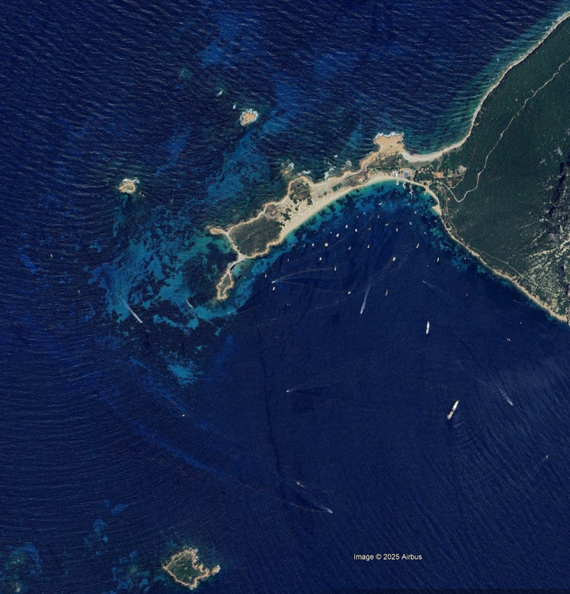
The answer comes from space. The team at CNR uses images from the PlanetScope satellites, which photograph the lagoon at 3-metre resolution roughly every day. At that scale a small boat is only a handful of pixels, and sometimes the clearest sign of its presence is the wake it leaves on the water. So the researchers taught an artificial intelligence to recognise them: after cutting each image into small tiles, they labelled the boats by hand, trained a detection algorithm, and then let it scan new scenes and place every boat on the map.
To check that it works, the results were compared with webcam footage of the canals, including the camera on the roof of the CNR-ISMAR building.
What the satellites saw
Applied to July 2025, the system analysed 107 satellite scenes and detected 10,281 boats. The AIS signals recorded within ten minutes of those same satellite passes, by comparison, number only 863.
The maps show where the lagoon is busier around Venice and Chioggia, and along some navigation channels, while some of the large channels turn out to be less used than the narrower inner ones.
The seasons leave their mark too. Boats in motion follow similar routes all year, with different intensity, but boats lying still are almost absent in winter and gather in summer in a few anchoring hotspots. Some of those hotspots lie near the shallows, where navigation and anchoring are restricted and habitats such as seagrass meadows may be disturbed.
And then, listening
Counting boats is only half of the story. In November 2025 two autonomous buoys were installed in the lagoon, weighed down by concrete blocks of about 700 kg each and lowered from the vessel Motonave Fusina. Each one measures underwater sound continuously and sends the data to shore, where scientists can follow sound levels in real time through a web interface. It is the first continuous sound monitoring of this kind in the lagoon.
In the Scanello channel, in the northern lagoon, researchers have also lowered a hydrophone paired with an underwater camera, to match what they hear with what they see. The recordings include the sounds of the lagoon's own inhabitants, from dolphin to gobies.
Satellites above, buoys below: together to better understand the underwater sound in a busy Lagoon.

