

TransH2: Paving the Way for Hydrogen-Powered Maritime Transport in the Adriatic
07/10/2026
A cleaner future for Adriatic ferry transport
The Adriatic Sea is home to an extensive network of passenger ferry routes that connect islands with the mainland and strengthen the links between Croatia and Italy. These services play a vital role in everyday life, tourism and regional development. Yet, despite their importance, most passenger vessels still rely on conventional fossil fuels, making maritime transport a significant source of greenhouse gas emissions.
As Europe moves towards climate neutrality and cleaner transport systems, the maritime sector faces increasing pressure to reduce its environmental impact. While hydrogen-powered vessels have already been tested in several Northern European countries, their application in the Adriatic has remained largely unexplored. Different sailing distances, port infrastructure and operational conditions mean that solutions developed elsewhere cannot simply be transferred to this region.
Recognising this challenge, the TransH2 – Transition to Hydrogen Fuelled Cross-Border Sea-Mobility project set out to explore whether green hydrogen could become a practical and sustainable energy source for regional and cross-border passenger shipping in the Adriatic. Rather than focusing on a single technology or location, the project examined the entire ecosystem required to support hydrogen-powered maritime transport—from vessel design and port infrastructure to stakeholder cooperation, investment planning and knowledge transfer.
Implemented over 30 months (February 2024 – July 2026) under the Interreg VI-A Italy–Croatia Programme, TransH2 brought together eight partners and four associated organisations from Croatia and Italy to explore how green hydrogen could support the transition to cleaner passenger maritime transport in the Adriatic. The total project budget was EUR 2,357,035, of which EUR 1,885,628 (80%) was provided through EU funding.
| Duration |
30 months |
| Countries |
Italy & Croatia |
| Partners |
8 |
| Associated Partners |
4 |
| Pilots |
3 |
| Vessel Concepts |
2 |
| Ports Assessed |
2 |
| Transnational Training Events |
4 |
| Table 1. TransH2 in a glance |
A partnership built on complementary expertise
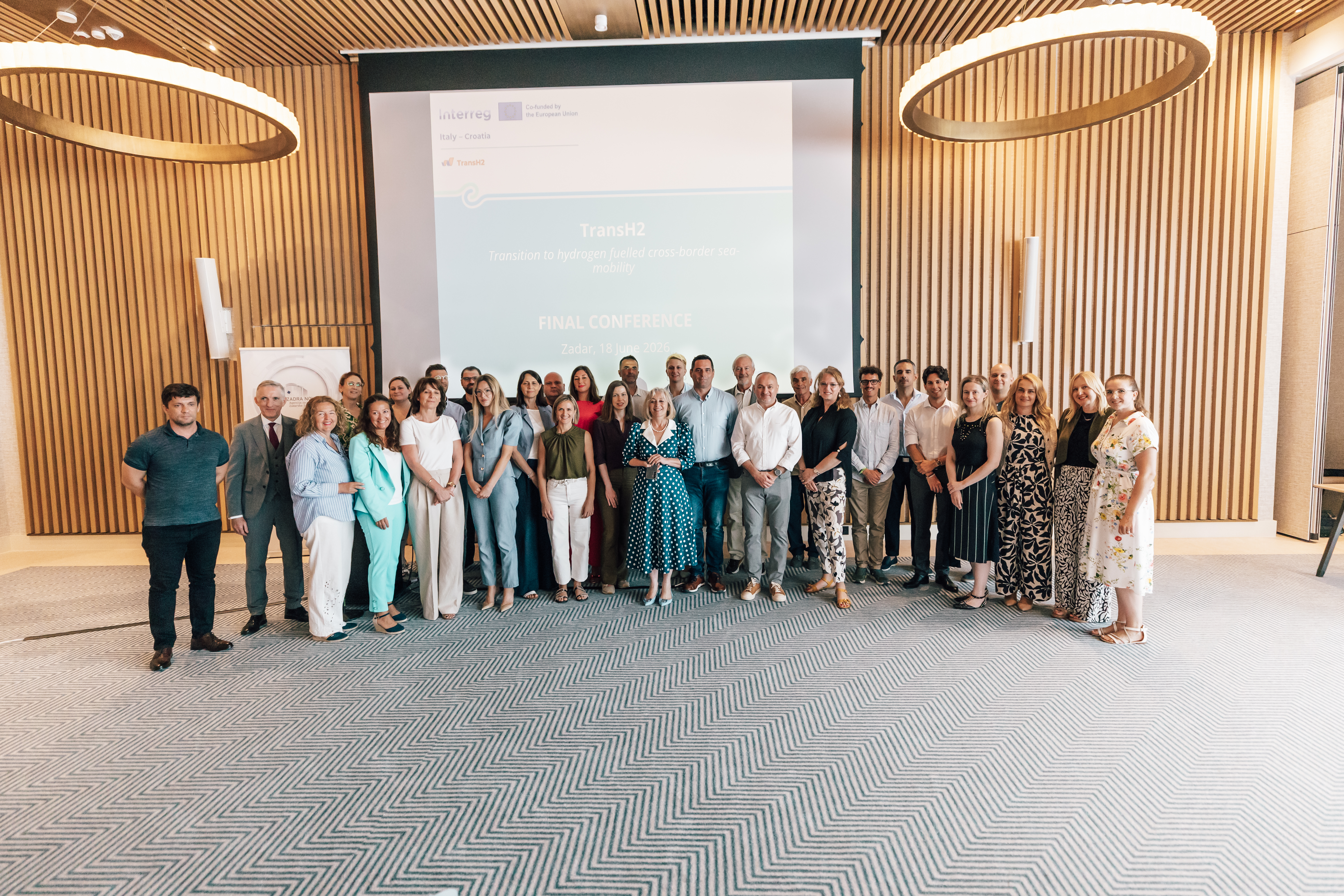
Successfully introducing hydrogen into maritime transport requires expertise from many different fields. For this reason, TransH2 brought together eight partner organisations from Croatia and Italy, each contributing its own knowledge and experience.
Together, the partners covered the full chain, from vessel design and port infrastructure to policy, training and investment planning.
The partnership was led by the University of Rijeka, Faculty of Maritime Studies (PFRI) and included the Croatian Chamber of Economy, Zadar County Development Agency ZADRA NOVA, Urbanex Ltd., Maritime, Aerospace, Renewable Energies Technology Cluster FVG (M.A.R.E. TC FVG), Navalprogetti Srl, Start Romagna S.p.A. and the University of Trieste.
The partnership was also supported by four associated organisations: the Croatian Ministry of the Sea, Transport and Infrastructure, the Zadar Port Authority, the Friuli Venezia Giulia Region, and Walter Tosto S.p.A., represented through its subsidiary Seastock. Their contribution brought valuable policy, port management and industrial perspectives to the project, helping to ensure that the proposed solutions were both technically sound and relevant for future implementation.
From ambition to practical solutions
The main goal of TransH2 was to demonstrate that hydrogen can become a realistic option for cleaner passenger maritime transport in the Adriatic. Instead of promoting a theoretical concept, the project focused on developing practical tools and evidence that can support future investments and informed decision-making.
Throughout the project, the partners combined technical expertise, research and cross-border cooperation to assess where hydrogen-powered vessels could be introduced, what infrastructure would be required to support them, and how public authorities, transport operators and industry can work together to make this transition possible.
The project focused on three representative ferry routes – one cross-border connection between Croatia and Italy (Ancona – Split) and two regional routes (Tronchetto – Lido and Split – Supetar), one in each country. Based on these use cases, two hydrogen-powered passenger vessel concepts were designed – one for cross-border and one for regional connections.
The feasibility of hydrogen refuelling infrastructure was assessed for two ports, Split and Trieste, providing practical guidance for future investments.
The partnership also organised four transnational training events, bringing together more than 150 participants from port authorities, transport operators, industry and research organisations.
Building on TransH2 results
The TransH2 results are ready to be used. The joint cross-border strategy, the pilot actions and the training scheme are openly available on the TransH2 project page and can be adapted to other ferry routes and ports in the Adriatic and the wider Mediterranean.
We invite port authorities, ferry operators, public authorities, technology providers and other projects to build on these results. The partners are available for consultations, technical clarification, training activities and knowledge exchange, including through the H2 maritime transport collaboration network.
For more information or to discuss cooperation, please contact the Lead Partner, the University of Rijeka, Faculty of Maritime Studies: edvard.tijan@pfri.uniri.hr

