

Your Green Vacation & AcquaGuard: International Scientific Conference on Smart Camps and Nature-based Solutions (NbS) for Sustainable Tourism
08/11/2025
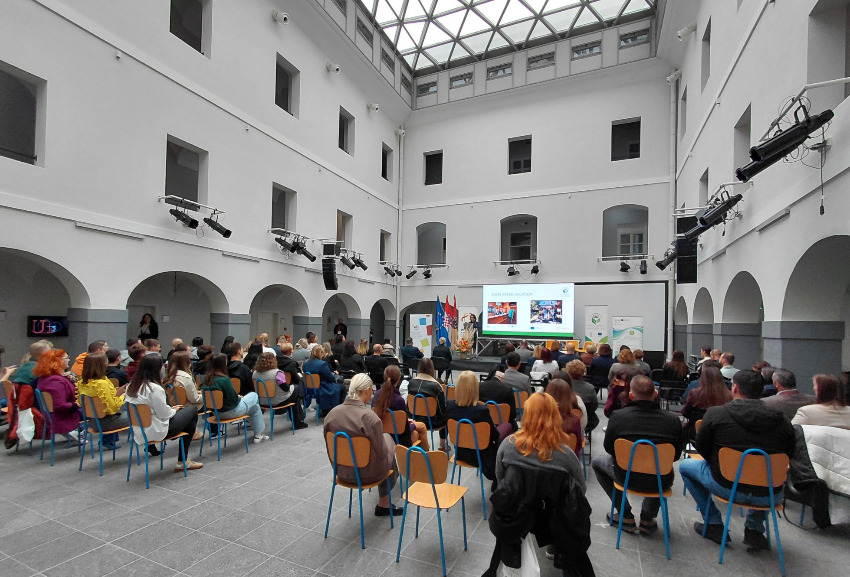
The International Scientific Conference “Your Green Vacation: Smart and Green Camps for a Sustainable Future of Tourism” was held on 7 November 2025 at the atrium of the Polytechnic University of Karlovac. The event was organized as part of the Your Green Vacation project (Polytechnic University of Karlovac) and the AcquaGuard project (Public Institution Regional Development Agency of Karlovac County).
The Conference brought together around one hundred experts in camping tourism, scientific institutions, and destination management from Croatia, Italy, and Portugal. In her opening remarks, the Prefect of Karlovac County, Martina Furdek Hajdin, emphasized that camping is “a sector that is highly sensitive but also adapts fastest to new challenges related to climate change,” framing the conference’s focus on climate risk adaptation, the preservation of natural values, and the development of sustainable tourism models.
Key Themes and Conference Content
The program was organized into several thematic sessions and panels, where experts presented research, best practices, and new technologies.
The main topics included:
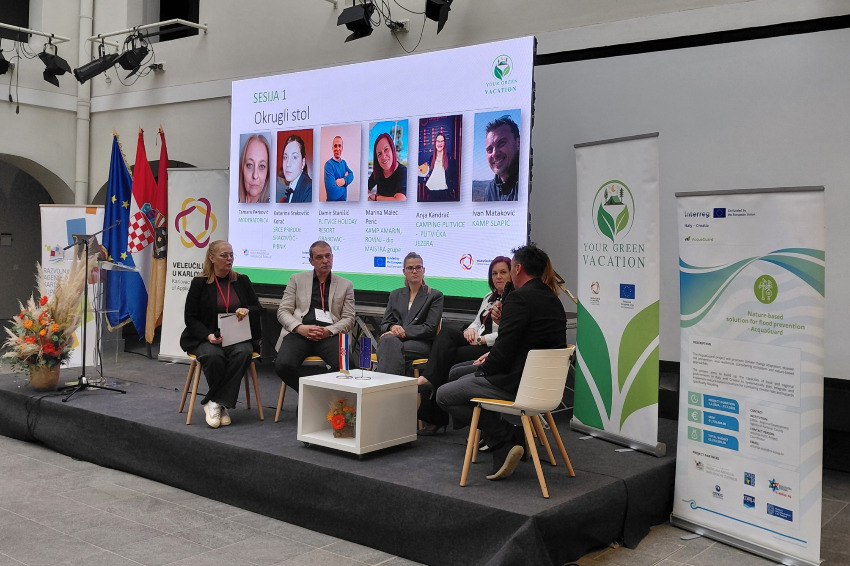
1. Camping Tourism and Sustainable Development (Session 1): Antonija Vučić (AcquaGuard Project) presented the application of Nature-based Solutions (NbS) in managing camps and tourist destinations. She highlighted the importance of natural solutions as tools for mitigating flood and other climate-related risks, emphasizing NbS’s role in integrating sustainable tourism with local development. Pilot sites and concrete measures were presented, including wetland restoration, green areas, and retention basins, demonstrating that NBS not only protect the environment but also enhance the tourism appeal of destinations. Tihana Cegur Radović (Your Green Vacation Project) presented research showing that most visitors respond positively to eco-friendly practices, that implementing natural and sustainable measures increases overall user satisfaction, and contributes to the long-term resilience of camps against climate change. Josipa Cvelić Bonifačić discussed professionalization in outdoor tourism education, while Meri Živković (Croatian Camping Association) introduced the concept of a “green revolution” in camps – operating in harmony with nature. A roundtable discussion covered experiences of Croatian camps (e.g., Slapić, Plitvice, Maistra) in implementing sustainable practices.
2. Smart Camps and Artificial Intelligence (Session 2): Matija Mandić introduced the concept of smart camping aligned with smart city technologies, while Mario Protulipac (Okviri znanja d.o.o.) emphasized that destinations without sustainable planning face high costs, highlighting the role of projects like AcquaGuard in achieving climate and sustainability objectives. Dubravko Milković discussed the innovative Hydrofoil model, and representatives from CMCC (Dal Barco and Favilli) presented the RHEA-DAPT system – a tool using artificial intelligence to support planning and decision-making.
3. International Perspectives and Research (Session 3): Research on visitor behavior in camps was presented. For example, Salete Esteves et al. analyzed visitor behavior in a camp in Vinhais (Portugal) and in Plitvice Lakes National Park using social media photographs. Sónia Nogueira (Polytechnic University of Bragança) introduced international educational initiatives in sustainable tourism.
4. Tourism and Environmental Protection – NbS in Practice (Session 4): The final session focused on Nature-based Solutions in tourism and challenges in protected areas. Tatjana Uzelac (STARUM) presented good practice examples, while Martina Pavlović and Marina Magdić discussed managing tourism pressures in Mrežnica Nature Park and Baraćeve Caves. Special emphasis was placed on how NbS, such as biological barriers and retention basins, can protect ecosystems and ensure sustainable tourism.
Examples of NBS Solutions
The conference highlighted practical applications of natural solutions in tourism and climate risk adaptation. Examples included investments in green energy in camps (solar plants, heat pumps) and smart camp management systems (mobile apps for registration and waste separation).
Flood mitigation planning through NBS was particularly emphasized. The AcquaGuard project identified two pilot sites – the former Luščić barracks and the Jamadol rainwater retention area – for developing project documentation for sustainable natural solutions (e.g., wetlands, retention basins) aimed at reducing flood risks. Other showcased solutions included green infrastructure in camps, the use of smart technologies and AI tools (e.g., RHEA-DAPT), the development of natural flood mitigation measures, and strategies for sustainable camping management aligned with local ecosystems.
Integrating NBS into the Tourism Sector through AcquaGuard.
The AcquaGuard project (Interreg Italy-Croatia) focuses on applying NbS for climate change adaptation and disaster risk reduction. Its goal is to strengthen the capacities of local and regional authorities for systematic planning and integration of natural measures for climate hazard protection, particularly floods. NBS implementation directly contributes to the resilience of tourism infrastructure and visitor safety, supporting the development of risk and NbS databases and decision-making tools that prioritize investment in natural measures over costly “grey” infrastructure solutions.
Conclusion and Reflection
The conference successfully brought together experts and showcased best practice examples of NBS and sustainable tourism. Participants emphasized that such events connect the academic community, tourism operators, and policymakers, providing concrete guidance for future sustainable tourism development, fostering a more resilient and greener tourism sector in Karlovac County and beyond.