BlueDiversity: a lasting legacy for a sustainable future and development of the sea
26/11/2026
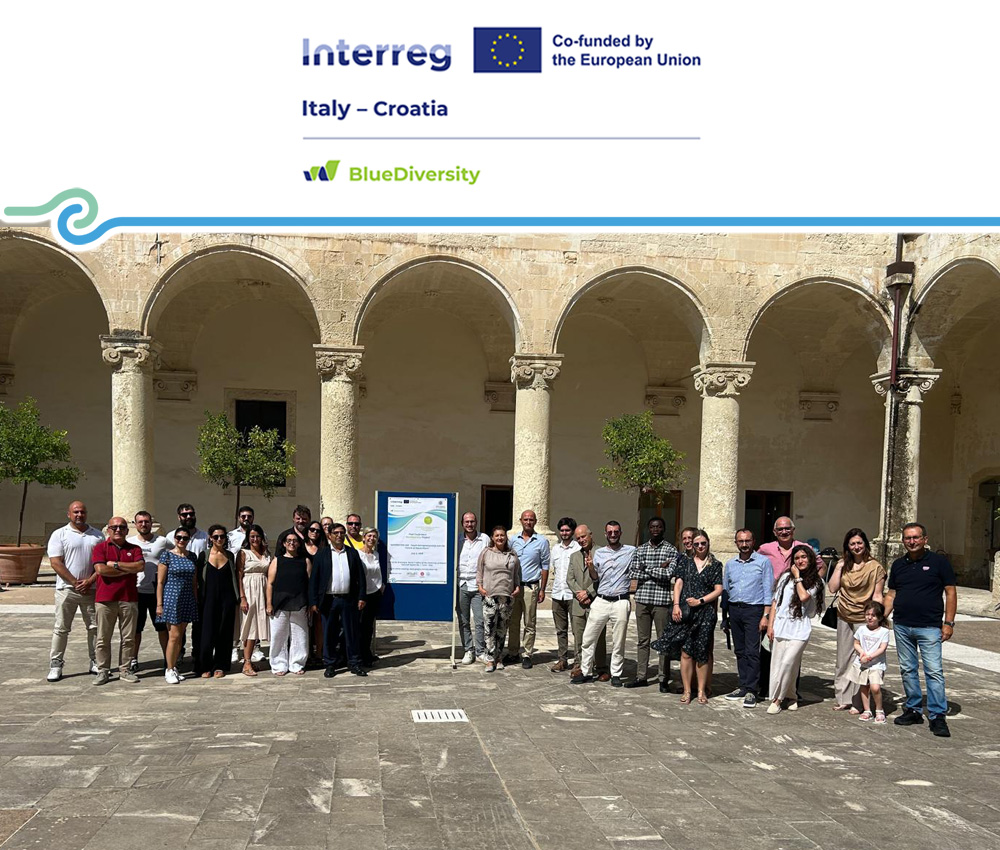
After more than two years of transnational cooperation, research, innovation and stakeholder engagement, the BlueDiversity project comes to a close, leaving behind a rich legacy of knowledge, tools and solutions for the protection and enhancement of marine and coastal biodiversity in the Adriatic Sea.
BlueDiversity brought together partners from Italy and Croatia with the shared ambition of addressing some of the most pressing environmental and socio-economic challenges affecting the Adriatic basin. Through a transnational and multidisciplinary approach, the project worked to strengthen biodiversity conservation, reduce the impacts of human activities on marine ecosystems, support sustainable fisheries and aquaculture, and create new opportunities for coastal communities.
The project demonstrated how cross-border cooperation can generate tangible and scalable solutions capable of responding to environmental challenges that transcend national boundaries. The Adriatic Sea is a shared ecosystem, and BlueDiversity has shown that only through collaboration between research institutions, businesses, local authorities, educators, fishers and citizens is it possible to ensure its long-term protection and sustainable development.
What are the main results achieved by BlueDiversity? Let’s take a look together!
A cutting-edge eDNA monitoring system
Among BlueDiversity's most innovative achievements is the implementation of a transnational biodiversity monitoring system based on environmental DNA (eDNA).
This advanced methodology allows researchers to identify and monitor marine species through genetic traces naturally released into the environment, providing highly accurate and non-invasive biodiversity assessments.
The study was published in 2026 in the scientific journal Ecology and Evolution in an article titled "Targeted eDNA Survey Enables Consistent Detection of the Invasive Blue Crab in Trans-Border Adriatic Coastal-Marine Ecosystems" and was implemented across six pilot areas in Italy and Croatia revealing that the blue crabs in these locations share the same fundamental genetic profile confirming that they originated from a single wave of dispersal likely originating from the Gulf of Mexico (De Donno et al., 2026). Environmental DNA has proven particularly effective for the early detection of alien and invasive species. By supporting timely interventions and evidence-based decision-making, the eDNA monitoring framework establishes a strong foundation for future cross-border biodiversity monitoring initiatives in the Adriatic Sea.
In another study currently awaiting publication, titled Multi-Marker eDNA Metabarcoding for Establishing a Transboundary Biodiversity Baseline in the Adriatic Sea’s Coastal and Marine Ecosystems, the BlueDiversity cross-border team discovered that multi-marker eDNA metabarcoding applications are particularly effective in describing biodiversity across a cross-border framework, furthermore highlighting that water temperature and dissolved oxygen are the primary factors determining which species inhabit a given location. The same method enabled us to identify, for the first time through a molecular survey, the ctenophore Mnemiopsis leidyi (an invasive, gelatinous, jellyfish-like species) in the Venice Lagoon and also to confirm the presence of the brown shrimp Penaeus aztecus in the Aquatina di Frigole lagoon (in Puglia) and to record its presence for the first time in the Bay of Mali Ston (in Croatia).
Advancing scientific knowledge on the blue crab
Scientific research played a central role throughout the project.
BlueDiversity partners carried out extensive studies on the ecology, population dynamics and nutritional characteristics of the Atlantic blue crab, generating valuable knowledge for both environmental management and potential market valorisation.
Among the most important scientific outputs is the publication on June 09, 2026 of the paper Heterogeneity of Atlantic blue crab (Callinectes sapidus) invasion stages and population structure in the Adriatic Sea in the internationally renowned journal Frontiers in Marine Science. The research provides important insights into the invasion patterns of the species in the Adriatic and contributes to the development of informed management strategies (Shauer et al., 2026). Using the Composite Invasion Index (CII), the results demonstrate that the invasion of the blue crab in the Adriatic is not uniform across different areas. These differences reflect the environmental gradients of the Adriatic and provide land and resource managers with a scalable tool for assessing the stages of the invasion.
Research on the blue crab invasion is also the focus of another article, published in 2025 in the scientific journal Scientific Reports, titled: Investigating invasion patterns of Callinectes sapidus and the relation with research effort and climate change in the Mediterranean Sea. By integrating 77 scientific publications with local reports from fishermen (336 reports, totaling over 15,000 specimens collected over a 58-year period, from 1965 to 2024), the research has reconstructed the invasion of the blue crab in the Adriatic and Ionian Seas and the central Mediterranean (Shauer et al., 2025). According to the observed results, the invasion is progressing from south to north and is currently accelerating. This expansion coincides with a significant rise in maximum monthly temperatures between the initial arrival phase and the subsequent expansion phase. The contribution from fishermen highlights the value of local ecological knowledge for early warning systems. This study proposes a transferable methodology for researching marine invasions linked to climate change and suggests considering the inclusion of this species on the list of species of concern for the European Union.
At the same time, studies on the nutritional properties and potential uses of blue crab have opened new perspectives for its integration into local food chains and the hospitality sector, supporting the transformation of an invasive species into a valuable economic resource.
In particular, in a further study currently awaiting publication, titled "Occurrence and dietary health risk of trace metals, polycyclic aromatic hydrocarbons and marine biotoxins in the invasive blue crab (Callinectes sapidus)" the results obtained in the BlueDiversity pilot areas has determined that, along the Adriatic coasts of Italy and Croatia, blue crab meat contains levels of cadmium, lead, and mercury that fall within EU-established limits, as well as low concentrations of polycyclic aromatic hydrocarbons (PAHs) and minimal amounts of marine biotoxins. In a preliminary assessment concerning the average adult consumer, all risk indices for metals and PAHs are within acceptable ranges; therefore, the blue crab can serve as a food resource—provided that monitoring continues—and its harvesting can help control an invasive species.
Innovative solutions for managing the blue crab emergency
One of the most significant achievements of the project has been the development and testing of innovative selective fishing traps designed specifically to address the growing impact of the invasive Atlantic blue crab (Callinectes sapidus).
Tested in different pilot areas across Italy and Croatia, these innovative devices were developed to help fishers manage the blue crab emergency while minimising impacts on native species and maintaining ecosystem balance. The project designed and validated a range of prototype traps suitable for different environmental conditions, providing practical and adaptable solutions that can support the fisheries sector throughout the Adriatic region and beyond.
These activities represent an important contribution towards transforming a major ecological challenge into an opportunity for sustainable resource management and economic resilience.
Promoting sustainable and plastic-free fisheries
BlueDiversity also focused on reducing one of the most widespread threats to marine ecosystems: plastic pollution.
Through pilot activities and field testing, the project explored and promoted alternative materials to conventional plastics used in fishing and mariculture. The objective was to reduce the release of plastic waste into the marine environment while encouraging the adoption of durable, recyclable and easily scalable solutions.
The results achieved demonstrate that circular approaches can effectively support both environmental protection and operational needs within the fisheries and aquaculture sectors, paving the way for more sustainable production models.
Building skills through education, training and living laboratories
Throughout its implementation, BlueDiversity invested heavily in capacity building and knowledge transfer.
Students, young professionals, fishers, entrepreneurs, SMEs, educators and local stakeholders actively participated in workshops, seminars, conferences, training courses, field activities and living labs organised by project partners across both countries.
These actions strengthened awareness of biodiversity conservation, ecosystem services, sustainable fisheries and blue economy opportunities, while encouraging the exchange of experiences and best practices between Italy and Croatia.
The educational dimension of the project has helped create a new generation of informed citizens and professionals capable of contributing to the sustainable management of marine and coastal resources.
Digital tools for learning and sustainable tourism
To ensure the long-term accessibility of project knowledge and results, BlueDiversity developed two innovative digital resources.
The BluE-Learning Platform provides an interregional educational environment featuring training modules, thematic courses and immersive learning experiences connected to the project's pilot areas. The platform supports the dissemination of scientific knowledge and practical skills related to marine biodiversity conservation and sustainable resource management.
Alongside this, the project created the Virtual Map Sustainable Tours, an interactive geographical portal through which users can explore pilot areas, environmental resources, project outcomes and sustainable tourism itineraries developed within the project framework.
Both tools remain available to the public and represent valuable resources for education, awareness-raising and knowledge sharing beyond the project's lifetime.
Engaging communities and strengthening cooperation
A defining characteristic of BlueDiversity has been its commitment to stakeholder engagement.
Throughout the project, strong cooperation was fostered among public authorities, researchers, fishers, SMEs, schools, environmental organisations, tourism operators and local communities. Through participatory activities, awareness campaigns and collaborative events, the project promoted a shared sense of responsibility towards marine and coastal ecosystems.
This network of relationships and partnerships represents one of the project's most valuable legacies and will continue to support future initiatives dedicated to biodiversity conservation and sustainable development.
A legacy that extends beyond the project
BlueDiversity concludes with a clear message: protecting biodiversity and supporting sustainable economic growth are complementary objectives.
The methodologies, scientific knowledge, monitoring protocols, educational resources, technological solutions and best practices developed during the project are replicable, transferable and freely available to support future initiatives across the Adriatic region and beyond.
By combining scientific excellence, innovation, education and cross-border cooperation, BlueDiversity has laid the foundations for a more resilient, sustainable and biodiversity-friendly future for the Adriatic Sea.
The project may have reached its conclusion, but its results, tools and partnerships will continue to inspire actions for the conservation and enhancement of marine and coastal biodiversity for years to come.
A heartfelt thank you goes to our partners for their commitment and professionalism, as well as to all the students, entrepreneurs, organizations, and institutions that took part in our initiatives and events, enabling us to make BlueDiversity a meaningful project for the community throughout this long journey of transnational exchange and cooperation.
To learn more about the project's key results and milestones, click on the dedicated links!

