


From Risk to Solution: AcquaGuard Webinar Explores Governance and Policy in Flood Risk Management
27/10/2026
How can Nature-based Solutions become an established part of flood-risk management when legislation, financing and institutional practices still favour conventional infrastructure?
This question was at the centre of the first AcquaGuard webinar, “Governance and Policy in Flood Risk Management,” held on 5 October 2026 as part of the From Risk to Solution webinar series.
The session brought together experts from Croatia and Italy to examine the opportunities and challenges of integrating Nature-based Solutions (NbS) into flood-risk governance, strategic planning and decision-making.
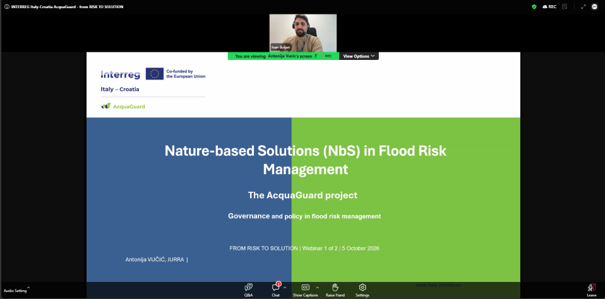
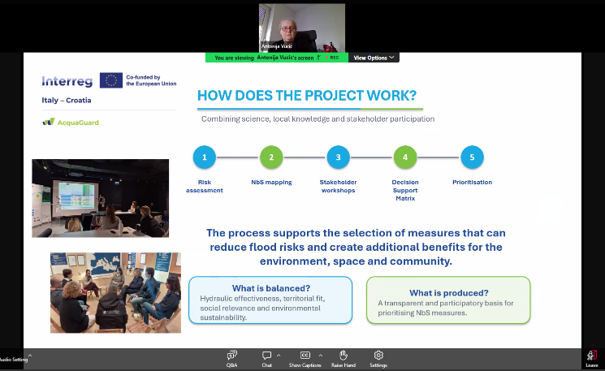
The webinar opened with Antonija Vučić, Project Manager at the Regional Development Agency of Karlovac County (JURRA), who introduced the AcquaGuard project and its approach to strengthening the capacities of local and regional authorities in Karlovac County and the Veneto region to systematically plan and prioritise Nature-based Solutions for flood-risk reduction.
What is preventing Nature-based Solutions from becoming mainstream?
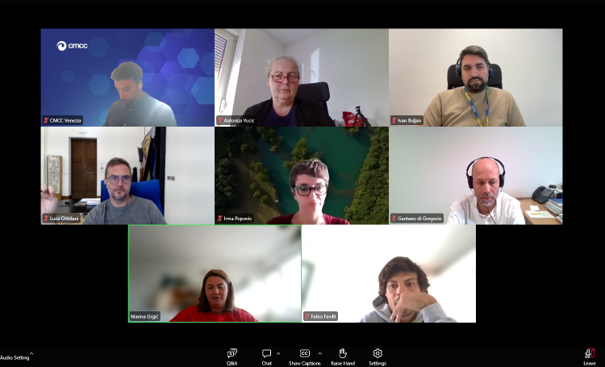
The central panel discussion, “Governance and Policy in Flood Risk Management,” was moderated by Ivan Buljan, Senior Project Manager – Climate at the North-West Croatia Regional Energy and Climate Agency (REGEA).
The panel featured four experts bringing complementary perspectives from environmental organisations, local government and European cooperation projects:
Irma Popović Dujmović, Freshwater Program Director for Croatia, The Nature Conservancy;
Luca Ortolani, City Councillor for Urban Planning, Environment, Mobility, and Security, Municipality of Faenza
Marina Grgić, Mura-Drava-Danube Lead, World Wide Fund for Nature (WWF);
Gaetano di Gregorio, Municipality of Cavallino Treporti, Italy.
One of the main issues discussed was the gap between growing interest in Nature-based Solutions and their recognition within existing policy and regulatory frameworks.
In Croatia, the limited recognition of NbS within national legislation and water-management strategies was identified as an important obstacle. The discussion also highlighted gaps in technical expertise, uncertainties surrounding long-term maintenance and challenges related to land ownership.
Experiences from Italy added another dimension: in historic urban centres and intensively cultivated areas, limited available space can make implementing larger Nature-based interventions particularly challenging.
These examples demonstrated that successful adoption of NbS requires more than technical feasibility. It also depends on regulatory clarity, institutional coordination and a shift in established planning and engineering practices.
Combining nature and conventional infrastructure
An important conclusion of the discussion was that Nature-based Solutions should not necessarily be seen as alternatives to conventional flood-protection infrastructure, but as complementary measures within integrated flood-risk management strategies.
Such hybrid approaches can combine the protective functions of traditional infrastructure with the wider environmental and social benefits offered by natural systems.
The panel also underlined the value of comprehensive restoration planning. Experiences from river restoration showed how well-structured, long-term plans can help simplify permitting procedures and provide a clearer framework for implementation than isolated interventions.
Financing remains a key challenge
Financing emerged as another significant barrier to scaling up Nature-based Solutions.
Current implementation often relies on project-based grants, including European funding programmes such as LIFE. While these instruments enable innovation and pilot initiatives, they do not always provide the continuity or scale required for broader territorial implementation.
The discussion highlighted the need for more integrated financing mechanisms that can support solutions delivering benefits across several sectors, from flood-risk reduction and biodiversity to agriculture and climate resilience.
Potential approaches included incentives for private developers and mechanisms that could encourage the participation of farmers and landowners, provided that appropriate regulatory and institutional frameworks are in place.
Building trust through evidence and communication
Beyond legislation and financing, participants also addressed the importance of public acceptance and long-term monitoring.
Nature-based Solutions may face resistance when their maintenance requirements, performance or benefits are insufficiently understood. The discussion highlighted the need to strengthen technical knowledge and provide practical evidence demonstrating how such solutions perform over time.
Long-term monitoring experiences from the Venice Lagoon, including observations of dune systems and sediment accumulation, offered an example of how environmental data can support understanding of natural processes and adaptation measures.
Equally important is communicating these benefits to local communities. Accessible case studies, educational initiatives and knowledge-sharing activities can help build public understanding and support for Nature-based approaches.
From policy ambition to implementation
The webinar reinforced a central message of AcquaGuard: mainstreaming Nature-based Solutions requires coordinated action across governance, legislation, finance, technical expertise and community engagement.
No single measure can overcome these challenges independently. Their wider application depends on combining strategic planning with practical knowledge, institutional commitment and evidence-based decision-making.
The question-and-answer session, moderated by Ivan Bulljan from REGEA, provided further opportunities for exchange, while Fabio Favilli from the Euro-Mediterranean Center on Climate Change (CMCC) delivered the closing remarks.
The discussion established the foundation for the second AcquaGuard webinar, held on 12 October 2026, which focused on practical tools, technologies and case studies demonstrating Nature-based Solutions in different territorial contexts.
We sincerely thank all panellists, moderators and participants for contributing their expertise and experiences to this important exchange.

