
Project Final Conference: A Shared Strategy for Archaeological Heritage and Sustainable Tourism
20/10/2026
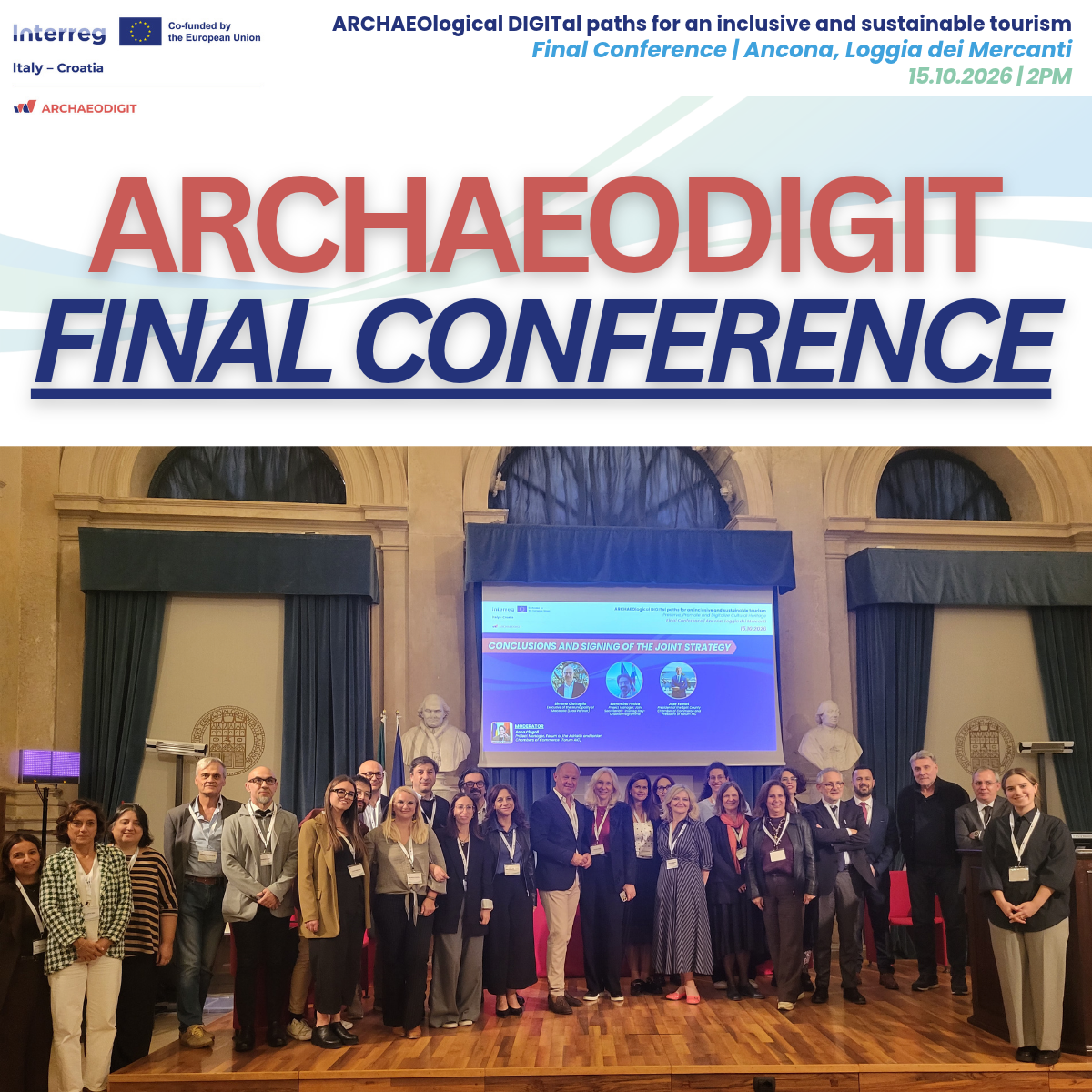
On 15 October 2026, the Loggia dei Mercanti in Ancona hosted the Final Conference of ARCHAEODIGIT (ARChaeological DIGITal Paths for an Inclusive and Sustainable Tourism), a cross-border cooperation project co-funded by the Interreg Italy-Croatia Programme and led by the Municipality of Macerata as Lead Partner.
The meeting brought together institutional representatives, universities, heritage protection bodies, technology partners, and cultural and tourism operators to share the project's results and discuss future prospects for enhancing archaeological heritage in the Adriatic-Ionian area.
The conference's guiding thread was the dialogue between heritage protection, digital innovation and sustainable tourism development: the aim is not simply to make sites more visible, but to provide tools to interpret them, make them accessible to different audiences and incorporate them into broader cultural and territorial networks.
Proceedings were moderated by Anna Cingoli, Project Manager at Forum AIC, Project Partner.
Institutional Greetings: European Cooperation, Territorial Development and Cultural Heritage
The opening session situated ARCHAEODIGIT within the broader framework of cooperation between Italy and Croatia, linking territorial policies and institutional networks with the need to develop innovative and sustainable approaches to understanding and experiencing heritage.
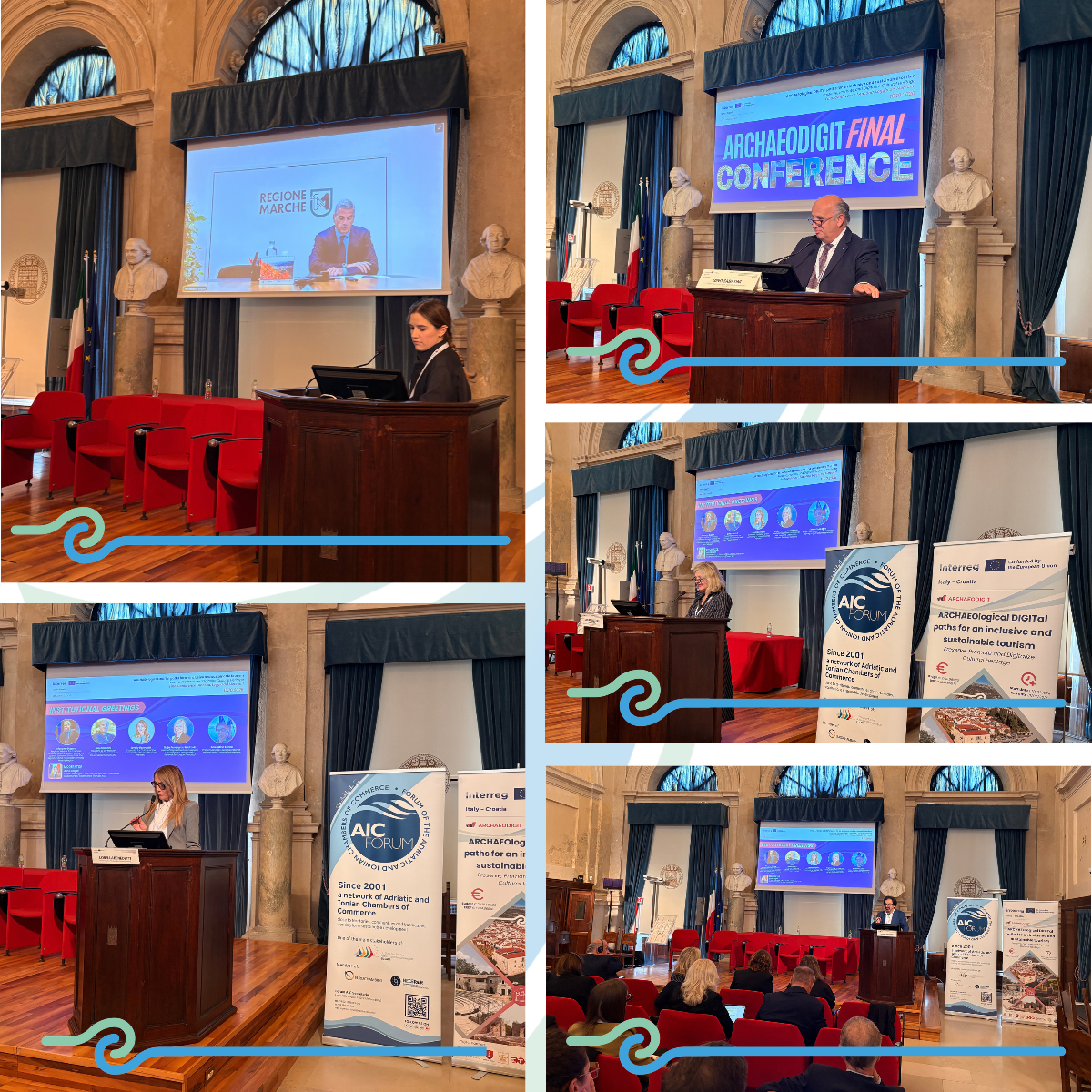
The preview of the project's final video was followed by a series of institutional greetings bringing together regional, chamber-of-commerce, municipal and cross-border perspectives.
Giacomo Bugaro, Councillor of the Marche Region responsible for Economic Development, European Policies, the Special Economic Zone, ports, the airport and the intermodal terminal, joined remotely. His contribution focused on the regional dimension of the project and the links between European policies, economic development and the enhancement of territorial resources—elements that form part of the context in which cross-border cooperation takes place. He also highlighted the importance of aligning regional development priorities with European policies to strengthen territorial competitiveness and foster new opportunities for cooperation across the Adriatic-Ionian Region.
Gino Sabatini, President of the Chamber of Commerce of the Marche Region and Vice-President of Forum AIC, highlighted the role of the chamber-of-commerce system in connecting cultural heritage, economic development and territorial cooperation. Drawing on the ARCHAEODIGIT project, he emphasised the economic value of the cultural and creative sector in the Marche Region and the potential of archaeological sites, museums and other cultural assets to strengthen territorial attractiveness, support local businesses and diversify tourism flows. Finally, he stressed the value of cross-border cooperation through Forum AIC and the need to ensure continuity for the partnerships and tools developed through the project, highlighting the opportunity to connect cultural heritage, local products, research and territorial development within the wider Adriatic-Ionian Region.
Lorella Benedetti, Councillor for Culture of the Municipality of Macerata, representing the project’s Lead Partner, emphasised the importance of collaboration among all project partners and of cross-border dialogue between the Italian and Croatian test areas. She thanked the partners for their commitment and contributions, highlighting how ARCHAEODIGIT demonstrated that cultural heritage is not static, but a living resource that continues to speak to the present. By improving accessibility and making history available to wider audiences, the project showed how heritage enhancement can foster tourism, support local communities and generate economic development. She also stressed that culture should be recognised not only for its intrinsic and social value, but also as a productive sector capable of creating opportunities for businesses and territories.
Lidija Pansegrau Hadrović, Head of the Department for European Macroregions within Croatia’s Directorate-General for Europe, brought the Croatian perspective to the institutional discussion, highlighting the role of European macro-regional policies in fostering cross-border cooperation. She emphasised the potential of digitalisation to make archaeological heritage more accessible and visible, particularly to younger generations, helping them engage with and appreciate their cultural heritage while contributing to its preservation for the future. She also underlined the role of the EUSAIR Strategy as a platform for cooperation across the Adriatic-Ionian Region, highlighting sustainable tourism as a key pillar through which cultural heritage can be valorised and contribute to the attractiveness and development of local territories.
Sorrentino Fatica, representing the Joint Secretariat of the Interreg Italy–Croatia Programme, highlighted the importance of effective cross-border cooperation and acknowledged the significant achievements resulting from the successful implementation of ARCHAEODIGIT. He emphasised that the meeting should not be seen as the conclusion of the project, but rather as an important milestone and an opportunity to build on the results achieved, ensuring continuity and further strengthening cooperation between the participating territories.
First Roundtable – Phygital Archaeology and the Reconstruction of Ancient Landscapes
The first session, dedicated to digitalisation for the conservation and enjoyment of archaeological heritage, explored how digital tools can help tell the story of archaeological sites, make historic landscapes easier to understand and offer more engaging experiences to visitors of different ages and with different needs. The discussion linked the scientific and management dimensions of heritage protection with the technological and educational solutions developed at ARCHAEODIGIT's pilot sites.
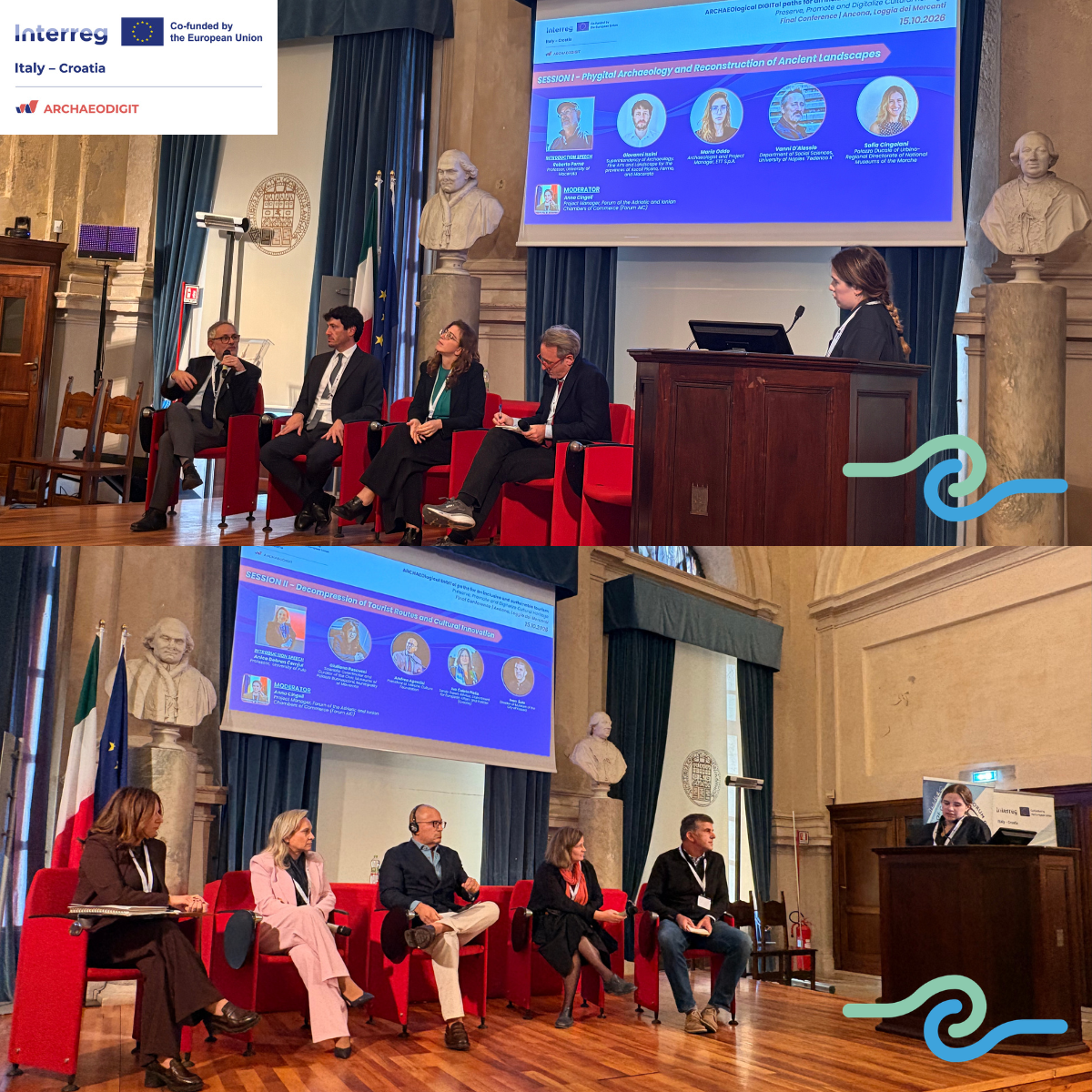
The introductory contribution was delivered by Professor Roberto Perna of the University of Macerata, who outlined the project's scientific and methodological contribution and the role of Management Plans. These tools provide a framework for organising knowledge about a site, defining priorities for its enhancement, and connecting conservation, management and public enjoyment. This approach provided a common basis for discussing how innovation can be embedded in long-term strategies rather than reduced to the introduction of individual technological applications.
Giovanni Issini, from the Superintendency of Archaeology, Fine Arts and Landscape for the provinces of Ascoli Piceno, Fermo and Macerata, addressed the application of digitalisation to the conservation of archaeological heritage. The central issue was the relationship between innovative tools and the responsibility to protect heritage: technology can help document, interpret and communicate heritage, but it must be integrated into the processes through which sites are studied and managed, while respecting their specific characteristics and conservation needs.
Maria Oddo, from ETT S.p.A., discussed immersive and interactive solutions through the ARCHAEODIGIT Platform, described as an integrated platform for interpreting archaeological, tourism and rural ecosystems. This perspective shifts the focus from an individual artefact or monument to the context that gives it meaning: archaeological content, tourism information and rural resources can be linked to give visitors a more comprehensive understanding of the landscape and territory. Digital integration thus becomes a way to build a narrative connecting each site with the cultural and environmental resources around it.
Vanni D'Alessio, from the Department of Social Sciences at the University of Naples Federico II, explored gamification activities and digital paths at the Fulfinum Mirine archaeological site. The theme was the inclusion of new audiences, with a focus on both adults and children. Playful activities and interactive narratives can turn a visit into a participatory experience, support learning and offer alternative ways of engaging with history while preserving the connection with the place and its heritage. The aim is to move beyond a purely observational model of visiting, encouraging more direct interaction between visitors, history and archaeological space.
Overall, the panel highlighted the complementary nature of these approaches: Management Plans provide the methodological framework, digitalisation contributes to knowledge and conservation, while immersive platforms and playful activities can broaden the ways in which heritage is accessed and interpreted.
Second Roundtable – Decongesting Tourist Routes and Cultural Innovation
The second session shifted the focus from individual sites to the urban and macro-regional scale. The issue of tourism “decongestion” was addressed as a need to diversify routes, distribute visitors more evenly across places and throughout the year, and connect well-known destinations with places and cultural resources that are less represented in traditional tourism circuits. From this perspective, Digital Cultural Paths can serve as narrative and connecting tools linking archaeology, historic theatres, audiovisual media, landscapes and agri-food heritage. Cultural tourism can thereby become a network of connected experiences, capable of enhancing different places and supporting a more balanced distribution of visitor flows.
The introduction by Anica Dobran Černjul, of the University of Pula, presented the tourism perspective, with particular attention to training, diversification of the offer and deseasonalisation. Creating sustainable itineraries requires more than identifying new stops: proposals must be recognisable, skills and operators must be connected, and cultural products must be designed to attract visitors beyond peak periods as well.
Giuliana Pascucci, from the Municipality of Macerata, addressed the transition from a management plan to an urban strategy through the case of Helvia Ricina and the proposed itinerary linking Macerata's three historic theatres. Her contribution illustrates how an archaeological site can be enhanced not only as a destination in its own right, but also as part of a broader cultural system connected with places of memory, architecture and the city's cultural activities. Linking archaeology and historic theatres opens up the possibility of creating a cross-cutting itinerary that brings together different resources and encourages visitors to spend more time exploring the area. Moving from a management plan to an urban strategy is an important element of the ARCHAEODIGIT approach: enhancing a site need not be limited to interventions at that location, but can form part of a comprehensive vision for the city's cultural development. A coordinated route can help distribute visitor interest across several places and strengthen the coherence of the urban offer.
Andrea Agostini, from the Marche Culture Foundation and the Marche Film Commission, turned the discussion to audiovisual media and cinema as potential drivers of tourism. Film productions and cinematic narratives can help make landscapes and destinations more recognisable, stimulate curiosity about the places shown on screen, and create opportunities to connect watching a film with discovering the territory. In this way, cultural heritage can become part of a broader story that reaches audiences beyond traditional tourism promotion channels. Audiovisual media therefore offers another narrative vehicle to strengthen places' identities and broaden the cultural offer.
Iva Čaleta Pleša, Senior Expert Advisor in Croatia's Department for European Affairs and Policies, explored the role of agri-food heritage in connecting minor archaeological sites with new tourist itineraries. The reference to the Mediterranean Diet makes it possible to integrate tangible heritage—sites, artefacts and landscapes—with traditions, knowledge, food practices and local products. This integration can enrich the visitor’s experience, strengthen the relationship between culture and local identity, and give people additional reasons to discover less-visited areas. The Mediterranean Diet is thus considered not merely an agri-food resource, but also an intangible cultural heritage that can contribute to the storytelling of territories and to the development of thematic itineraries.
Ivan Šuta, Director of the City Museum of Kaštela, introduced the experience of the UNESCO sites in Trogir, addressing the management of overtourism through thematic routes. His contribution offered a useful perspective on how itineraries organised around different themes and points of interest can encourage visitors to explore the wider area, reduce concentration around individual attractions and distribute the benefits of tourism more evenly.
In summary, the discussion highlighted the potential to develop an integrated offer in which an archaeological site is not an isolated point, but a gateway to a diverse cultural landscape. Digital tools can support these connections, providing narrative continuity between different places and making it easier for audiences to understand how they relate to one another.
The Joint Strategy: A Shared Vision for the Adriatic-Ionian Area
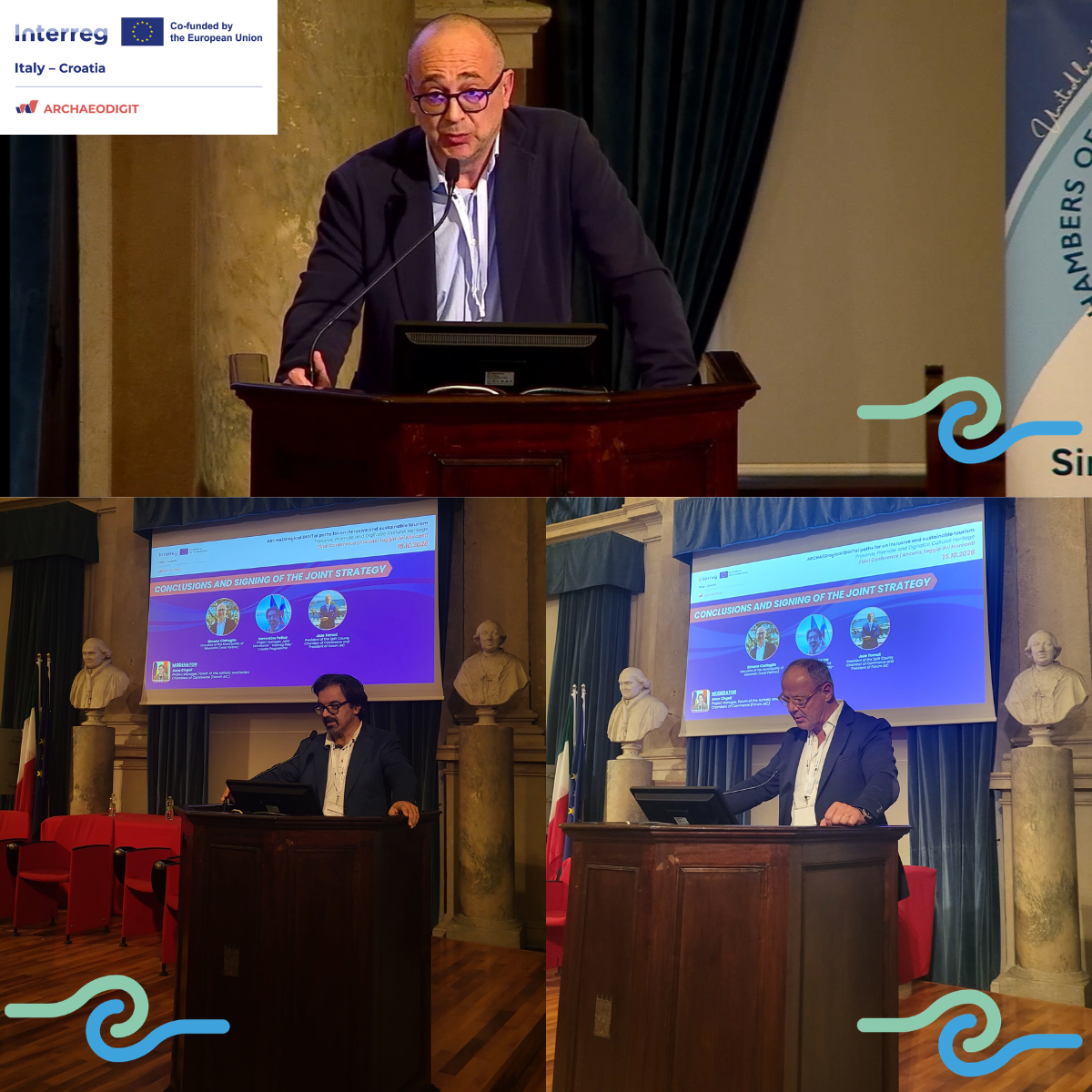
The conference concluded with the presentation and official signing of the ARCHAEODIGIT Joint Strategy by the partnership and associated organisations.
Simone Ciattaglia, an executive of the Municipality of Macerata and representative of the Lead Partner, presented the strategy as a new model of participatory governance for Adriatic-Ionian heritage. The institutional conclusions were entrusted to Sorrentino Fatica, on behalf of the Joint Secretariat of the Interreg Italy-Croatia Programme, and Joze Tomaš, President of the Split County Chamber of Commerce and of Forum AIC. President Tomaš closed the proceedings by linking ARCHAEODIGIT with the following day's event dedicated to the Mediterranean Diet as an intangible cultural heritage and an element of identity for the Macroregion.
The signing of the Joint Strategy marks the transition from the project's results to a shared framework for future cooperation. The vision is to connect digital tools, heritage protection and management, cultural institutions, communities and tourism operators, so that the experiences developed can also be applied and adapted in other territorial contexts.
Key Messages
The main themes that emerged during the proceedings were:
- Innovation in the service of heritage protection. Digital and immersive technologies are tools for interpretation and accessibility and should be integrated into careful, sustainable site management.
- More inclusive access. Interactive paths, gaming and gamification can engage different audiences, including younger generations, while strengthening the educational dimension of cultural experiences.
- Cultural networks beyond individual sites. Minor archaeological sites, historic theatres, cinema, cultural landscapes and agri-food traditions can become connected stops along richer and more recognisable itineraries.
- A more balanced distribution of tourism over time and space. Diversifying the offer and deseasonalising visitor flows can strengthen the appeal of inland areas and reduce pressure on the most frequented destinations.
- Cooperation and continuity. The Joint Strategy and dissemination activities provide a basis for maintaining cross-border relationships and supporting the transferability of the methodologies developed.
The Final Conference reaffirmed ARCHAEODIGIT's commitment to viewing archaeological heritage not as an isolated resource, but as part of a wider cultural and territorial ecosystem. The project's legacy is a vision in which scientific knowledge, digital innovation and collaboration between institutions and operators can support forms of tourism that are more accessible, more evenly distributed and more sustainable throughout the Adriatic-Ionian area.