

SHADOWS, STONES, AND STORIES: Discovering the Science of Time at CaleidoCamp
03/09/2026
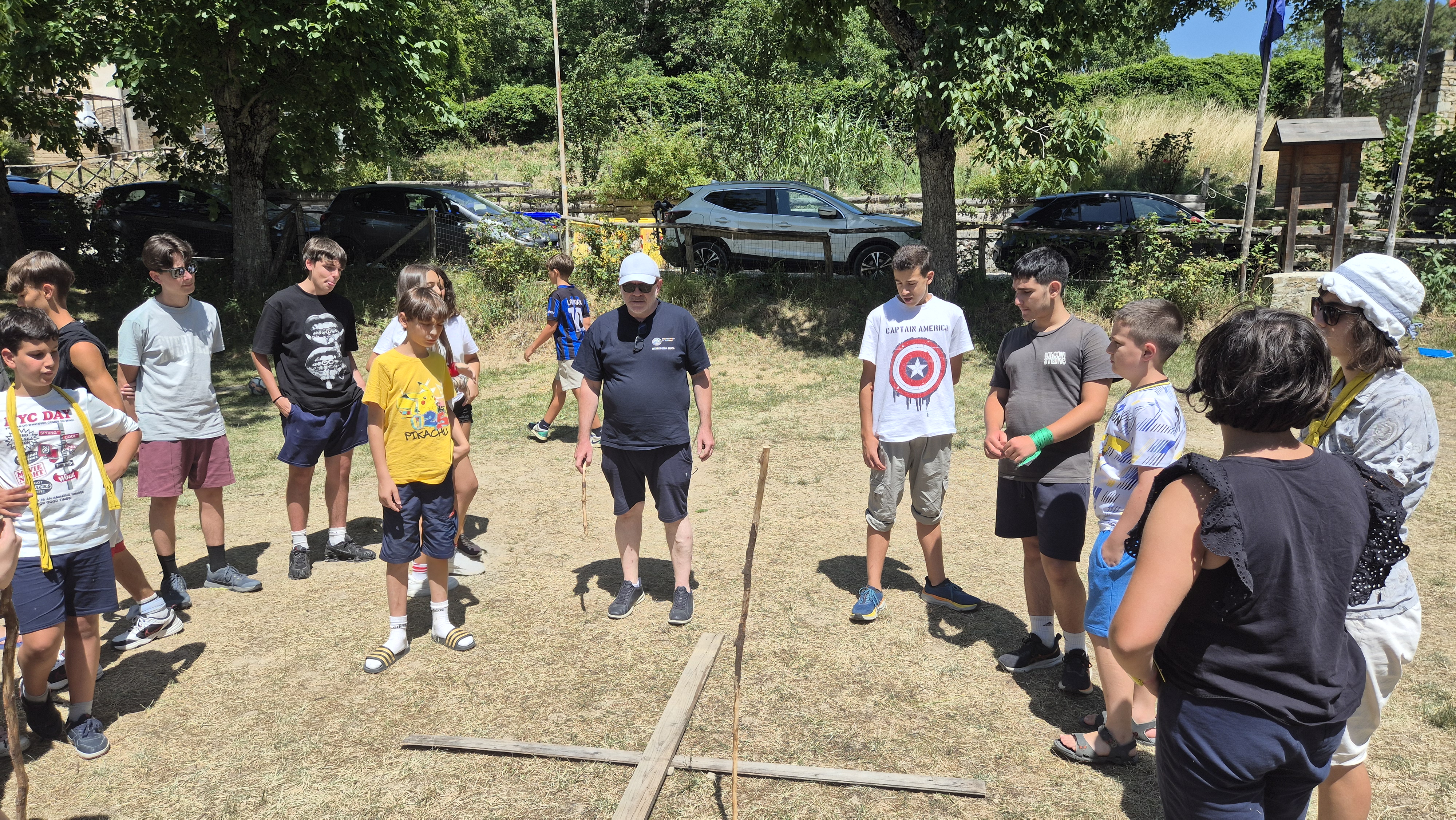
On July 18th, alongside the initiatives organised by the Lead partner, Municipality of Grottammare, the scenic setting of Altino di Montemonaco (AP, Italy) became a living laboratory for a group of young explorers. During a week dedicated to the "CaleidoCamp" theater camp—organized by Caleidoscopio APS for participants aged 11 to 16—the TIMELESS ADRIATIC project took center stage through a unique experiential workshop led by Ing. Oronzo Mauro.
The day’s challenge was to understand and build a solar clock —a sundial— from scratch. To guide the students through this journey, the project relied on the expertise of Oronzo Mauro, an engineer and science historian who is widely recognized as one of Italy’s leading experts in ancient scientific instrumentation. As the Scientific Director of the Clock Museum of Montefiore dell’Aso, Mauro has dedicated over 25 years to studying and restoring the mechanical and scientific heritage that once regulated public life. His work is central to the "Le Città del tempo delle Marche" network, which connects municipalities—including Grottammare—committed to valorizing historic clocks (If you want to know more about “Le Città del tempo” you can read the article about it in the Library section).
The workshop began with a deep dive into the TIMELESS ADRIATIC project, explaining to the young participants what it is about and what actions are planned for the upcoming months.
Mauro captivated the young audience by discussing the concept of time, encouraging them to place major historical events along a vast timeline to visualize how the human perception of time has evolved.
A particularly fascinating segment of the theoretical introduction focused on the different "types" of time recognized in various eras. Mauro explained the distinction between Chronos (chronological, sequential time) and Kairos (the opportune or qualitative moment), illustrating how ancient civilizations understood the rhythm of life before the invention of the mechanical clock. This historical narrative provided the perfect bridge to explain the technical birth of the mechanical timepieces that would eventually dominate civic towers across the Adriatic.
Moving from theory to practice, the group transitioned to a meadow where Mauro taught the participants how to identify cardinal points without modern technology. Under his guidance, the students utilized natural elements found on-site—stones and sticks—to construct a functional solar clock. By carefully placing these elements, they were able to observe the shifting shadow cast by the central stick, marking the relentless passage of time through the movement of the sun.
The reaction from the teenagers was incredibly positive. They participated with lively interest, interacting with Mauro through numerous questions and demonstrating a keen curiosity about how their ancestors navigated their everyday life.
This hands-on experience mirrors the broader mission of the TIMELESS ADRIATIC project: to use creative and collaborative methods to provide new energy, new rhythm, and new visions to shared heritage.
By transforming a simple meadow into an experimental space for collective learning, this workshop proved that the history of time is not just a subject for museums, but a vibrant tool for youth engagement and scientific discovery.

