
One Sea, One Language: New Protocols Approved to Harmonise Adriatic Environmental Data
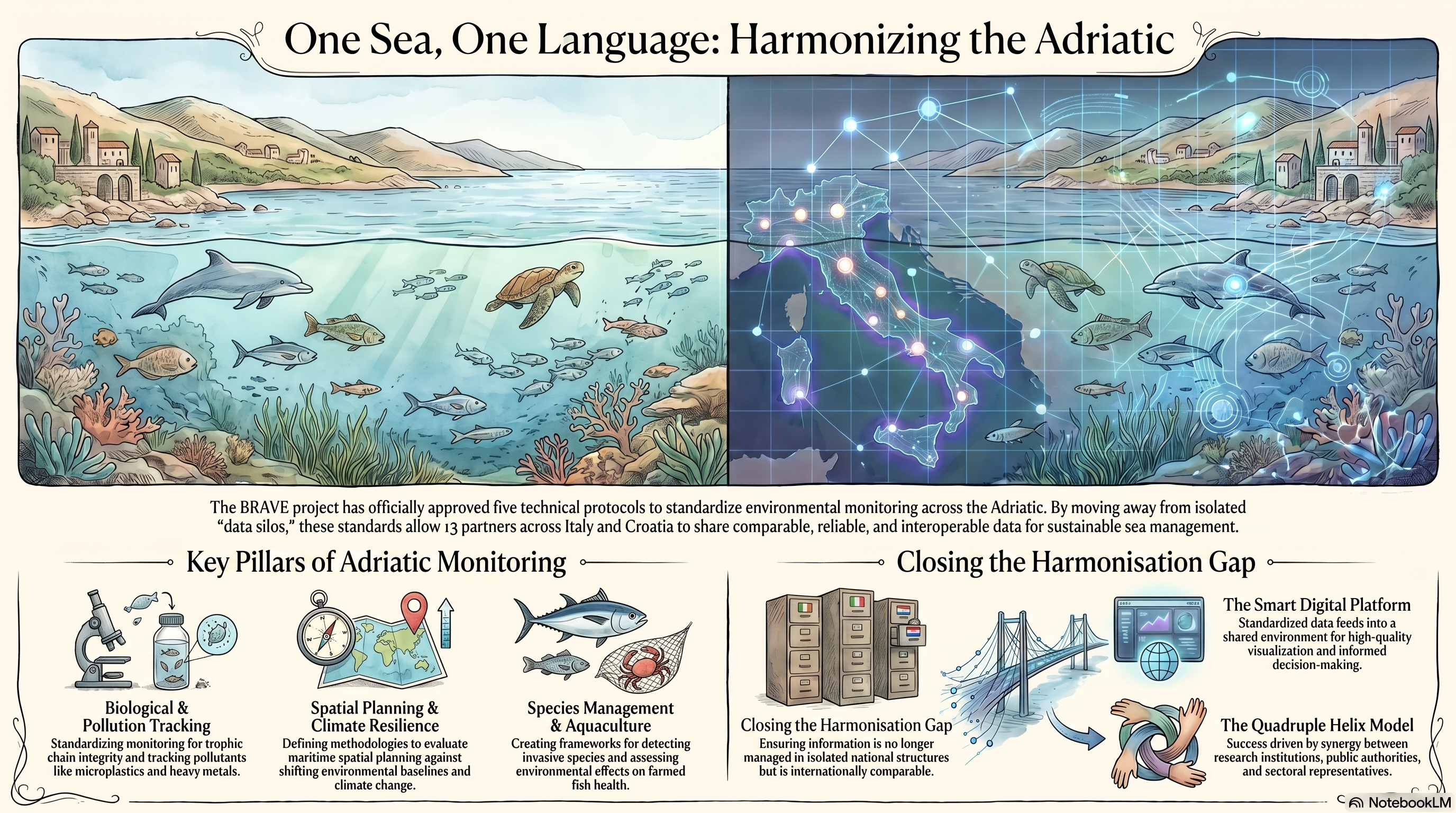
The BRAVE project has officially approved five new data protocols to break down information silos between Italy and Croatia. This milestone ensures that environmental data across the Adriatic is finally comparable, reliable, and ready for evidence-based policymaking.
We are proud to announce a significant technical and strategic achievement for the BRAVE project. Following an intensive period of collaborative work between technical staff across the partnership and the scientific experts of the Adriatic Advisory Committee (AAC), the Project Steering Committee has officially approved the five deliverable protocols related to our Common Data Collection Standards.
This approval represents a fundamental pillar of our mission to build a more resilient Adriatic Sea environment. In a region as ecologically complex as the Adriatic, environmental pressures—such as pollution, climate change, and invasive species—do not respect national borders. Historically, environmental data has been collected in "silos," managed within isolated national or sector-specific structures. By establishing these five standards, the BRAVE project takes a decisive step forward in limiting the "Data Harmonisation Gap," ensuring that information generated by our 13 partners across Italy and Croatia is finally comparable, reliable, and interoperable.
The Five Pillars of Adriatic Monitoring
The approved protocols (Deliverables D.1.1.3 through D.1.1.7) define shared operational frameworks across five critical thematic areas:
-
Trophic Chain Integrity and Primary Production: Standardising how we monitor the fundamental biological components that sustain our coastal and lagoon ecosystems.
-
Major Pollution Inputs: Establishing a transnational approach to tracking pollutants, such as microplastics and heavy metals, from inland waters to the sea.
-
Maritime Spatial Planning (MSP) and Climate Change: Defining methodologies to evaluate the efficacy of spatial planning in the face of shifting environmental baselines.
-
Invasive Alien Species (IAS): Creating a scalable framework for the early detection and management of non-indigenous species, such as the blue crab.
-
Target Species Production and Mitigation: Harmonising monitoring in aquaculture systems to assess how environmental variability affects the health and productivity of farmed fish and molluscs.
A Foundation for Evidence-Based Governance
Beyond technical specifications, these protocols serve a vital governance function. By adopting internationally recognized standards, we are ensuring that the data collected within our pilot actions can be seamlessly integrated into the BRAVE Smart Digital Platform. This shared digital environment will soon allow policymakers, researchers, and maritime operators to access high-quality data visualisations and analytical tools for informed decision-making.
This milestone is a testament to the power of the Quadruple Helix model. The synergy between research institutions, public authorities, and sectoral representatives has transformed a highly technical set of requirements into a practical, transferable tool for the entire Adriatic basin.
As we move into the implementation phase of our pilot actions, these standards ensure that our work today will provide a durable scientific legacy for the sustainable management of the Adriatic Sea for years to come.