
Open access publication
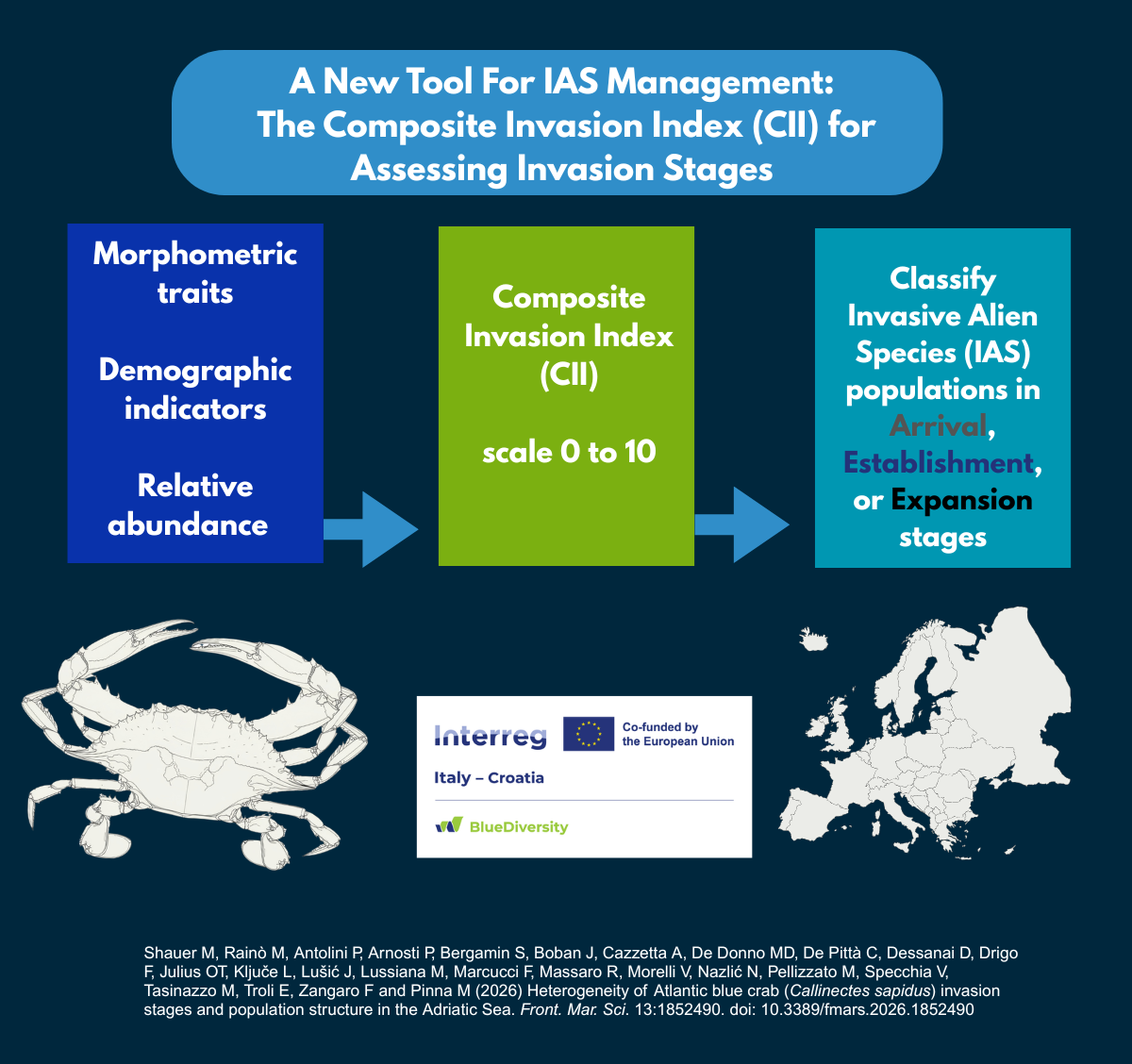
The study provides a tangible response to one of the most urgent ecological and socio-economic challenges in the Adriatic basin: the monitoring and strategic management of Invasive Alien Species (IAS), with a specific focus on the Atlantic blue crab (Callinectes sapidus).
A coordinated monitoring programme was implemented in the pilot areas of the BlueDiversity project across the Adriatic Sea. The research covered four macro-regions (North, Central-East, Central-West, and South), focusing on marine-coastal areas, including estuaries and lagoons protected by the European Natura 2000 network.
Key findings
The study revealed a marked spatial heterogeneity in the population structure in the Adriatic Sea during the 15 months of monitoring from October 2024 to December 2025:
● North Adriatic populations: characterised by high density and a dominance of adult individuals, reflecting an establishment stage sustained by the nutrient-rich lagoons;
● Central-East populations: were also dominated by adults, but with a relatively lower abundance. Ultimately classifying them as early establishment;
● Central-West and South Adriatic populations: characterised by a high juvenile presence, a higher proportion of females, and the greatest abundance observed. This indicated an active expansion stage, favoured by warmer, more saline waters that could stimulate recruitment of the species.
This paper represents a recognition of the shared commitment among universities, research bodies, and institutions involved in the BlueDiversity project, confirming the vital importance of cross-border cooperation for the protection of Adriatic biodiversity.