

Building Offshore Wind Farms for People and Nature: The BEYOND Project’s Holistic Vision for the Adriatic Sea
20/02/2026
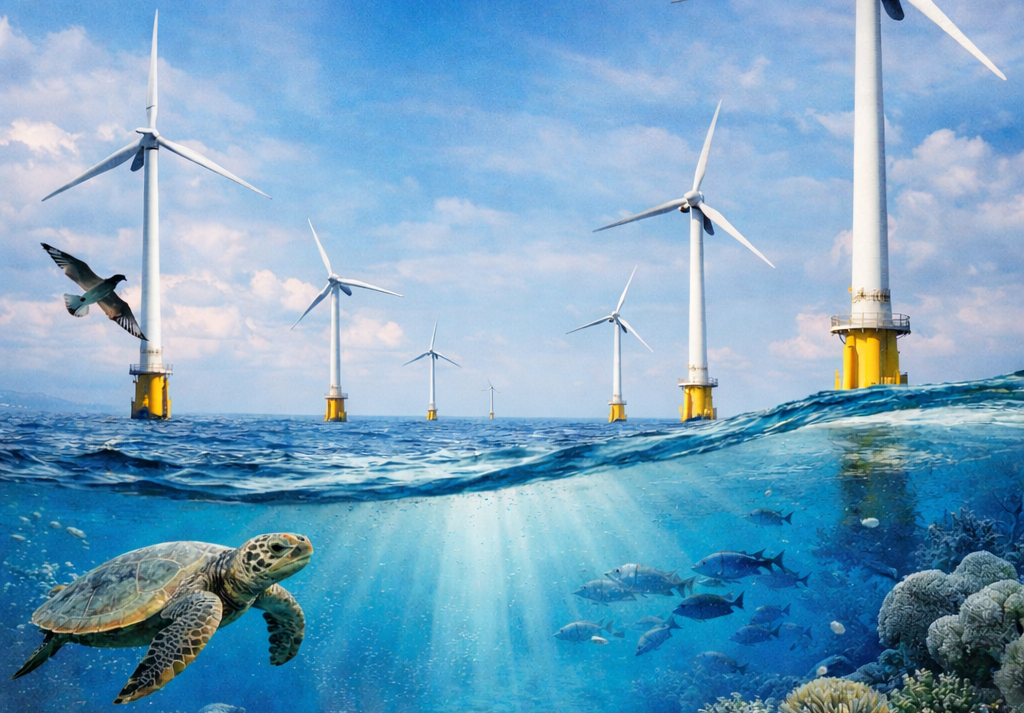
At the heart of the BEYOND project lies a simple but powerful idea: offshore wind farms (OWFs) in the Adriatic Sea should not be designed as isolated energy installations, but as part of a living, interconnected marine system that supports both nature and people. This holistic vision aims to guide the growth of renewable energy in one of Europe’s most sensitive and diverse marine regions, ensuring that clean energy generation is aligned with environmental sustainability and social inclusion.
Funded by the Interreg Italy–Croatia Programme, BEYOND brings together scientists, policymakers, and local communities to develop a comprehensive model for planning OWFs that is grounded in both ecological understanding and real-world experience. The Adriatic, with its rich biodiversity, dynamic ecosystems, and dense human activity—from fishing and aquaculture to tourism and shipping—offers both great potential and considerable complexity. The challenge is to reconcile these competing interests through informed, coordinated decision-making.
A Holistic Model for Offshore Wind Planning
BEYOND’s model approaches this challenge from three complementary angles. First, ecosystem modelling provides the scientific foundation for this approach. By utilising advanced ecological simulations, researchers can anticipate how wind farm structures might influence marine habitats, species distribution, and ecosystem services. These models reveal both opportunities and risks: while turbine foundations can serve as artificial reefs that attract new marine life and enhance local biodiversity, the construction process can generate underwater noise and alter sediment patterns, potentially affecting sensitive species.
Second, the project utilises scenario analysis to translate science into strategy. By testing different spatial layouts and development options, BEYOND helps decision-makers visualise what various futures could look like—some maximising energy output, others prioritising ecosystem health or local economic benefits. This allows for the identification of “win–win” scenarios that balance ecological preservation with economic development.
The third and equally crucial pillar is stakeholder engagement. BEYOND recognises that effective offshore wind planning cannot be achieved without the voices of those who depend on the sea. Fishermen, aquaculture operators, tourism representatives, policymakers, and community members all contribute their knowledge through workshops,
interviews, and participatory mapping. These interactions ensure that the planning process reflects local realities, builds trust, and lays the groundwork for long-term social acceptance.
Together, these three pillars—ecosystem modelling, scenario analysis, and stakeholder participation—form an integrated planning tool that connects data, dialogue, and decision-making.
Turning Knowledge into Coordination
This holistic approach is particularly valuable in a region as intricate as the Adriatic, where marine and human systems are deeply interwoven. By combining scientific models with participatory processes, BEYOND enables informed and coordinated decision-making—helping stakeholders understand not only the direct impacts of OWFs but also their broader implications for fisheries, tourism, and coastal economies.
The model’s strength lies in its ability to bring multiple interests to the same table. For instance, ecological insights about the effects of artificial reefs can be shared with fishermen, while spatial analyses can help planners avoid conflicts with shipping lanes or conservation zones. This transparent exchange of information reduces tensions between sectors and helps to align national and regional objectives across borders.
What the Project Has Revealed
Through its integrated research, BEYOND has uncovered a nuanced picture of how offshore wind development might reshape the Adriatic’s environmental and socio-economic landscape.
Environmentally, the project shows that OWFs—when planned carefully—can actually contribute to marine biodiversity. Turbine foundations can act as new habitats, increasing fish abundance and potentially benefiting commercial fisheries through a spillover effect. However, these positive outcomes depend heavily on responsible design and management. Construction noise, for example, can disturb marine mammals and fish, while changes in local hydrodynamics may affect sediment transport and water quality. BEYOND’s findings, therefore, emphasise the importance of timing construction phases and maintaining continuous environmental monitoring to minimise disruption.
On the socio-economic side, the project highlights promising opportunities for coexistence and innovation. OWFs can be integrated with existing maritime industries, such as aquaculture, to create multi-use offshore platforms that diversify income for coastal communities. Moreover, the development of OWFs brings the potential for local job creation not just during construction, but also through ongoing maintenance, logistics, and service
operations. This helps stimulate the blue economy, contributing to regional growth while supporting the transition to renewable energy.
Just as importantly, BEYOND’s emphasis on stakeholder engagement has fostered a sense of transparency and shared ownership. Early involvement of local actors builds trust and helps prevent conflicts that might otherwise delay or derail projects. It also opens up space for creative solutions, such as compensation schemes or access-sharing arrangements for fishermen, ensuring that the benefits of offshore wind are more widely distributed.
From Insights to Policy: A Path Forward
Beyond the technical and social lessons, the project’s outcomes carry significant policy implications. BEYOND advocates for a shift toward integrated maritime spatial planning (MSP)—a framework that considers all marine uses and their cumulative impacts together, rather than in isolation. By embedding OWF planning within MSP, policymakers can identify synergies, reduce spatial conflicts, and make more efficient use of marine resources.
Equally, BEYOND recommends the adoption of adaptive management strategies that maintain flexible decision-making. As new data emerge on environmental or socio-economic conditions, policies and operations can be adjusted to stay aligned with sustainability goals.
Crucially, the project underlines the need for cross-border cooperation between Italy and Croatia. Because the Adriatic is a shared sea, its management must also be shared. Coordinated governance structures and joint monitoring programs will be crucial to harmonising standards, sharing data, and addressing transboundary impacts effectively.
Finally, BEYOND envisions OWFs as more than just energy infrastructures—they can become hubs for blue innovation, supporting marine conservation, sustainable fisheries, and tourism. In this way, offshore wind can act as a catalyst for broader transformation toward a resilient and diversified coastal economy.
Balancing Promise and Complexity
Like any ambitious initiative, BEYOND’s holistic model faces challenges. Its data requirements are demanding, and stakeholder engagement processes can be time-consuming. Uncertainties persist regarding the long-term ecological effects of large-scale offshore wind development. Yet the advantages far outweigh these obstacles. The model provides a transparent, evidence-based pathway that connects scientific knowledge, local experience, and political will, thereby creating the foundation for decisions that are both credible and inclusive.
Conclusion: A New Way to Plan for the Sea
Ultimately, the BEYOND project represents a novel approach to thinking about energy, environment, and society in the Adriatic Sea. It demonstrates that offshore wind development can be planned not as a trade-off between progress and preservation, but as a shared endeavour that brings multiple benefits when guided by cooperation and knowledge.
As Europe accelerates its transition to renewable energy, the lessons from BEYOND are timely and far-reaching. By weaving together environmental science, socio-economic insight, and participatory governance, the project demonstrates how the Adriatic can become a model for inclusive, ecosystem-based offshore wind planning. With continued research and strong transnational collaboration, the region has the opportunity to lead by example—building a future where offshore wind farms not only power clean energy, but also thriving marine ecosystems and vibrant coastal communities.