

The AWASTER – Adopting WASTE as Resource project has released a report summarizing the implementation of educational workshops on resource efficiency, carried out across Italy and Croatia as part of the Interreg Italy–Croatia Programme 2021–2027.
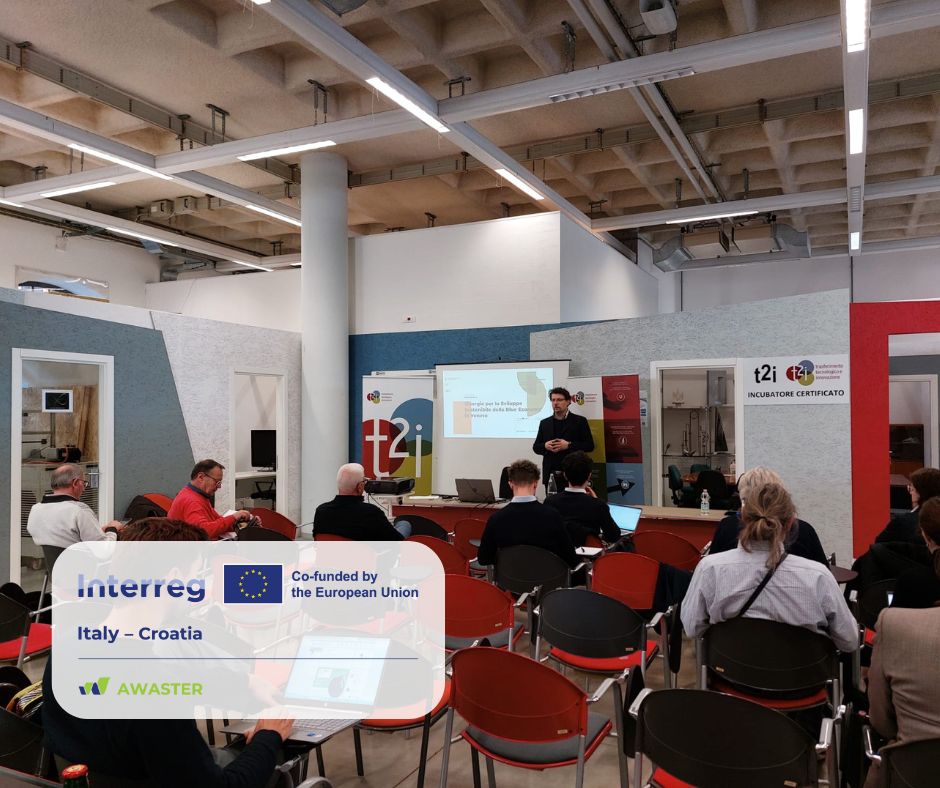
Between March 2025 and February 2026, a total of 10 workshops were organized in five pilot regions: Istria, Split-Dalmatia, Veneto, Apulia, and Dubrovnik-Neretva. Engaging 286 participants from 149 organizations, the workshops primarily targeted representatives of the business sector. That included: small and medium-sized enterprises (SMEs) operating in tourism, manufacturing, and agriculture, as well as public authorities, NGOs, and educational institutions.
The main objective of these activities was to strengthen knowledge and promote the adoption of circular economy principles, with a focus on reducing waste generation and improving resource efficiency in business operations. Through a combination of theoretical sessions and practical, hands-on activities, participants were introduced to concepts such as zero-waste practices, sustainable resource management, and circular business models.
Workshops addressed sector-specific challenges and opportunities, for example in the HORECA sector, where participants explored ways to reduce food waste, optimize procurement and storage, and improve waste separation and bio-waste management. In Split-Dalmatia, practical zero-waste cooking sessions demonstrated how to use ingredients more efficiently, while other sessions focused on sustainability communication and avoiding greenwashing.
Findings from the report highlight that awareness of circular economy concepts is increasing, but remains uneven across sectors and regions. Many businesses have already adopted basic practices such as waste separation. However, more advanced solutions such as reuse systems, circular design, or renewable energy integration - are still limited.
The report also identifies key barriers to wider adoption, which are often not primarily financial, but related to limited knowledge, lack of technical guidance, time constraints, and insufficient infrastructure. At the same time, strong interest and motivation among participants indicate significant potential for further development, especially when supported by practical tools, mentoring, and access to funding opportunities.
The workshops demonstrated that interactive and experience-based learning such as real-life case studies, peer exchange, and hands-on exercises has the greatest impact in encouraging businesses to adopt more sustainable practices.
For a complete overview of the workshops and their outcomes, see the report attached.