


Climate Change and Territories: Local Strategies for a Sustainable Future
16/06/2025
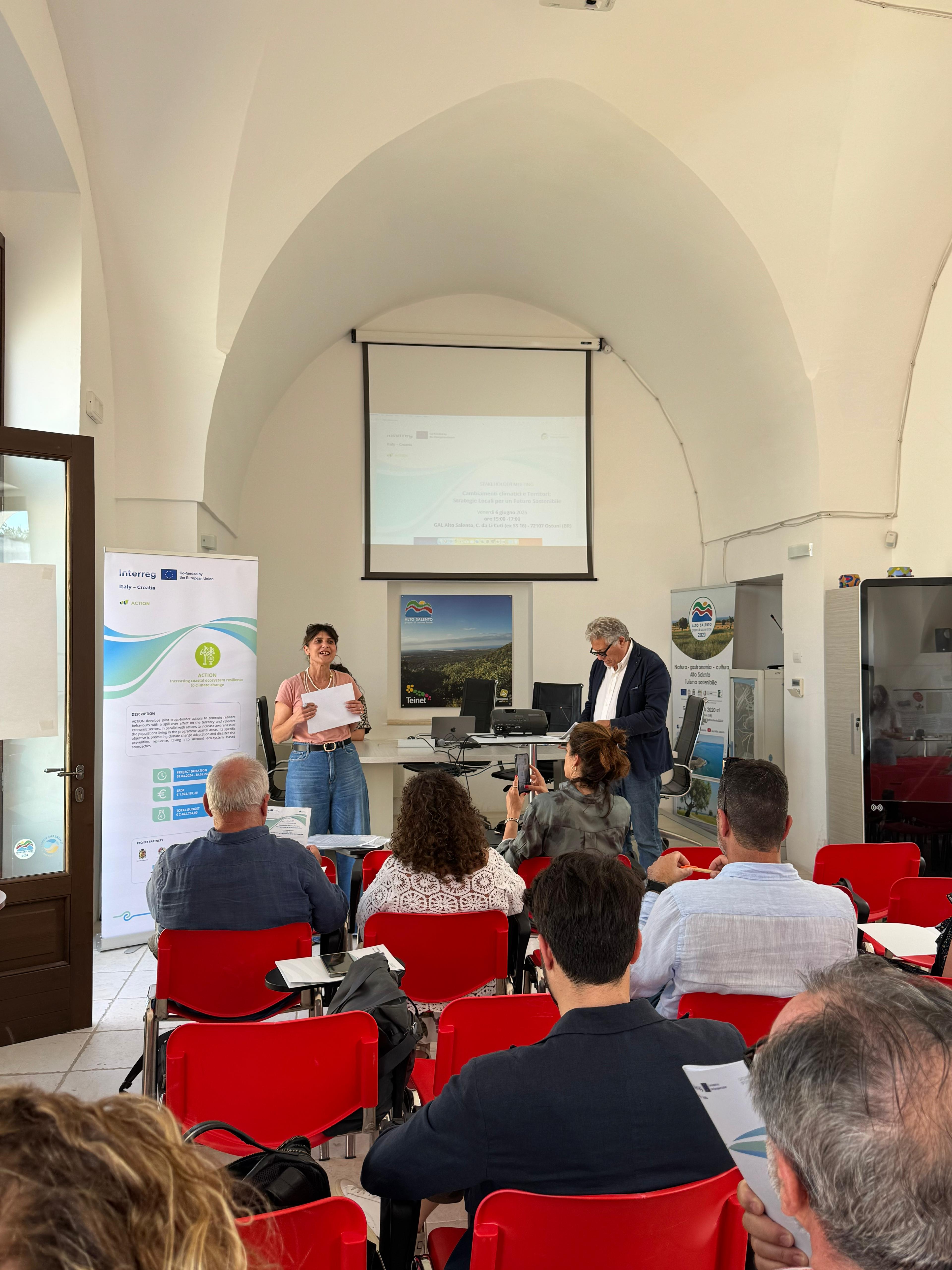
On June 6th 2025, the Park of the Coastal Dunes hosted the stakeholder meeting organised as part of the ACTION project. The meeting, entitled “Climate Change and Territories: Local Strategies for a Sustainable Future,” was held at the headquarters of GAL Alto Salento in Ostuni, Puglia. It was an opportunity to bring together stakeholders from different sectors, each with a key role in tackling climate change challenges.
The event began with institutional greetings from Annarita Angelini, President of the Park, followed by Michele Lastilla, Director of the Park, who introduced the invited stakeholders. The Director then presented an overview of the ACTION project, highlighting both ongoing and upcoming activities, with a particular focus on those concerning the Park of Coastal Dunes. He outlined the key initiatives of the project, including ecological and socio-economic analysis, as well as the continuous monitoring of the park. A central aspect of his presentation was the pilot action, which is based on the results of habitat monitoring and the assessment of climate change-related risks. This data will be used to develop an action plan aimed at creating a preliminary mitigation project to protect the Park’s coastal area. Additionally, he emphasised that the project seeks to develop practical guidelines for transferring these solutions to other territories involved in the programme.
Afterwards, Michele Lastilla introduced the Professor Mauro Agnoletti, president of the “National Association of Rural Landscapes and Landscapes of Historical Interest”, who delivered an insightful presentation titled “Resilient Agriculture and the FAO-GIAHS Programme”. His speech began with an introduction to UNESCO and the FAO’s programme “Globally Important Agricultural Heritage Systems” (GIAHS). GIAHS is an initiative by the FAO that recognises and supports agricultural systems around the world that are of global importance due to their combination of cultural heritage, biodiversity, and sustainable agricultural practices. He then discussed resilient agricultural models, showcasing systems that have adapted to challenging environments, such as extreme droughts, high humidity, mountainous terrains, or areas affected by natural disasters. Through these examples, he stressed the importance of resilient agriculture in the face of climate change, highlighting how such challenges push populations to develop new forms of adaptation for survival. He concluded by emphasizing the need to protect territories and the agricultural sector to preserve resources, ensure food security, and promote long-term sustainability amid growing climate instability.
Following this insightful presentation, a round table discussion was held. On this occasion, stakeholders such as Cristina Monti (Member of the Supervisory Committee of the Rural Development Program of the Puglia region), Valerio Palasciano (Project Manager at Tecnopolis PST), Francesco Paolo Fanizzi (Professor at the University of Salento), and Domenico Ragno (Member of the National Forest Restoration Association) took part.
The focus of their discussion was primarily an in-depth analysis of the most common problems affecting the Puglia region, which are further amplified by climate change. Among these problems, particular mention was made of water scarcity, which is becoming an increasingly critical issue, with serious impacts on the availability of water resources for agriculture. In addition, the problem of plant diseases, such as Xylella fastidiosa, which is threatening olive crops, a key sector for the regional agricultural economy, was highlighted. These factors contribute to weakening small local producers, who are already vulnerable and face increasing difficulties in maintaining the quality of their typical products, such as olive oil, a symbol of Apulian tradition. Participants agreed that the interaction between climate change and these agronomic challenges makes it increasingly urgent to adopt adaptation strategies that can protect agricultural systems and ensure the economic and environmental sustainability of the region.
In conclusion, the meeting highlighted the urgent need for collaborative efforts in addressing the challenges posed by climate change, particularly in the agricultural sector. By engaging stakeholders from various sectors, the event emphasiSed the importance of developing sustainable, adaptive strategies to safeguard both the environment and local economies in the face of ongoing climate impacts.