Words that Matter
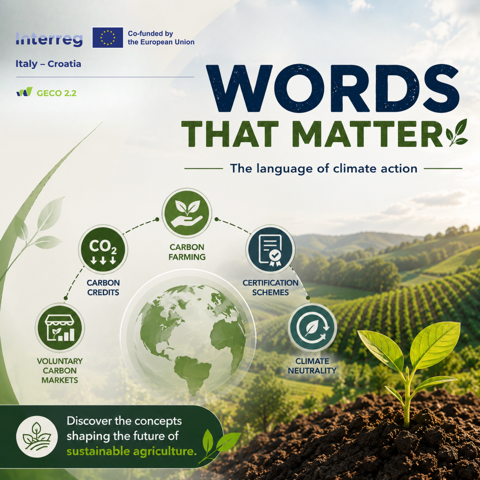
Carbon credits. Carbon farming. Certification schemes. Voluntary carbon markets. Climate neutrality. These are not just technical terms. They are concepts that are increasingly shaping the future of agriculture, environmental policies, and the transition towards a low-carbon economy. Over the past years, GECO2.2 has worked to transform these concepts into practical tools, supporting farmers, testing innovative methodologies, and contributing to the development of transparent and credible carbon market solutions. To make these topics more accessible and easier to understand, the project is launching “Words That Matter”, a communication series dedicated to explaining the key concepts behind carbon farming, carbon markets, certification systems and climate action.
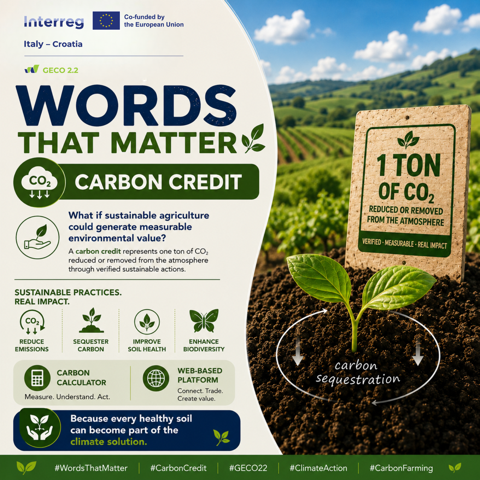
Carbon Credit
A carbon credit represents one ton of CO₂ that has been reduced or removed from the atmosphere through verified sustainable actions.
Within GECO2.2, carbon credits are linked to agricultural practices that enhance the capacity of soils and crops to naturally sequester carbon. These practices include cover crops, reduced tillage, agroforestry, biochar application, crop rotation and improved farm management efficiency.
Together, these approaches increase the land’s carbon sequestration potential while improving soil health and biodiversity.
GECO2.2 is developing tools and methodologies to measure these environmental benefits and support farmers in the transition towards more sustainable agricultural systems, including a carbon calculator and a web-based platform for carbon credit exchange.
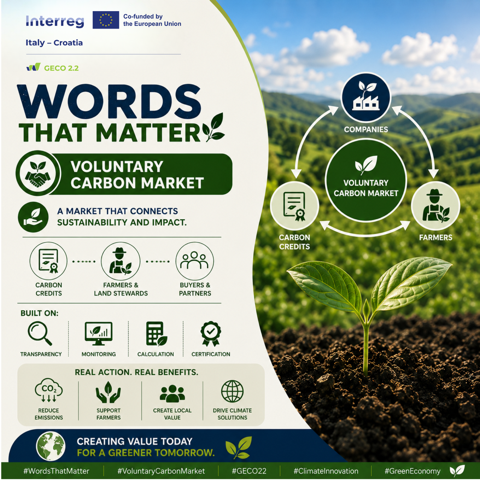
Voluntary Carbon Market
A Voluntary Carbon Market (VCM) is a system in which companies, organizations and individuals voluntarily purchase carbon credits to offset or compensate for their greenhouse gas emissions. Unlike compliance markets, such as the EU Emissions Trading System (EU ETS), participation in voluntary carbon markets is not legally required. GECO2.2 is working to develop a regional voluntary carbon market connected to sustainable agriculture and carbon farming practices. The project aims to create a system based on transparent carbon credit registries, digital monitoring and verification tools, carbon calculation systems and certification approaches aligned with EU regulatory standards. The objective is to create value for communities, farmers and territories while supporting climate action.
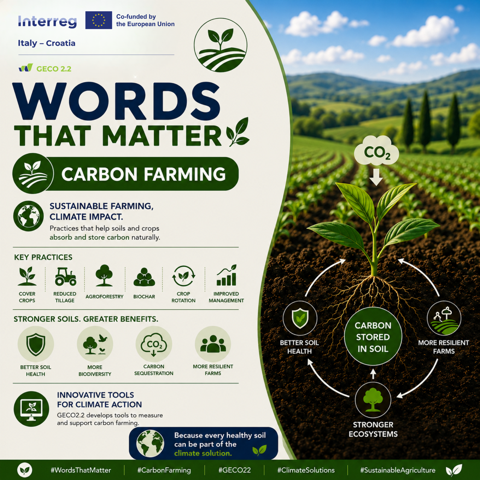
Carbon Farming
Carbon farming refers to a set of agricultural practices and land management approaches that increase the capacity of soils, plants and ecosystems to absorb and sequester carbon dioxide from the atmosphere while reducing greenhouse gas emissions.
The European Commission has recognised carbon farming as a key pathway towards more resilient and sustainable agricultural systems, notably through the Farm to Fork Strategy and the EU Carbon Removal Certification Framework. In GECO2.2, carbon farming contributes to healthier and more productive soils, lower agricultural emissions, greater biodiversity and more sustainable land management. The project promotes practices such as cover crops, reduced soil disturbance, organic matter enhancement and agroforestry solutions.
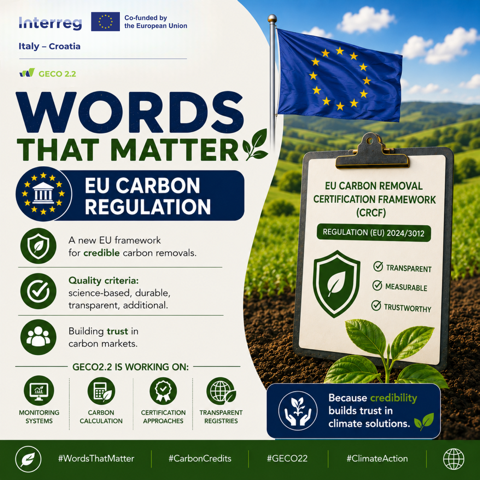
Eu Carbon Removal Regulation
The European Union has adopted the Carbon Removal Certification Framework (CRCF), Regulation (EU) 2024/3012, to ensure that carbon removal activities are transparent, measurable and trustworthy. The regulation establishes quality criteria requiring that carbon removal activities be quantified through robust scientific methodologies, demonstrate long-term durability, be transparent and verified, and provide additional benefits beyond business-as-usual practices. GECO2.2 closely follows this evolving regulatory framework and is developing methodologies, monitoring systems and carbon registries aligned with future European standards.
Certification Scheme
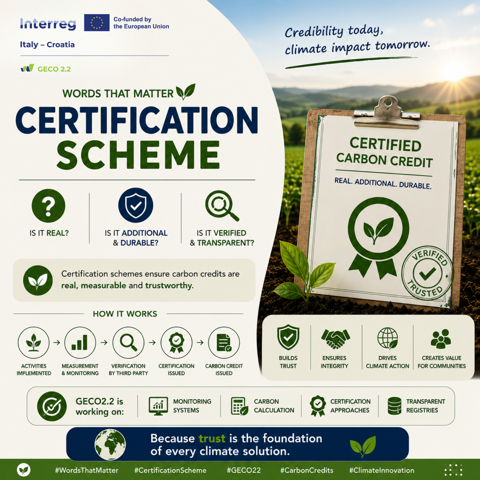
A certification scheme is a system used to verify that climate-related activities generate measurable, additional and lasting environmental benefits. Certification schemes ensure that carbon credits are real, quantifiable, transparent and based on genuine climate impact.
Under the EU Carbon Removal Certification Framework, certification schemes will play a central role in ensuring the credibility and integrity of voluntary carbon markets. GECO2.2 is actively working on monitoring methodologies, agricultural data collection systems, digital verification tools and transparent carbon registries to support the development of reliable and accessible certification systems.
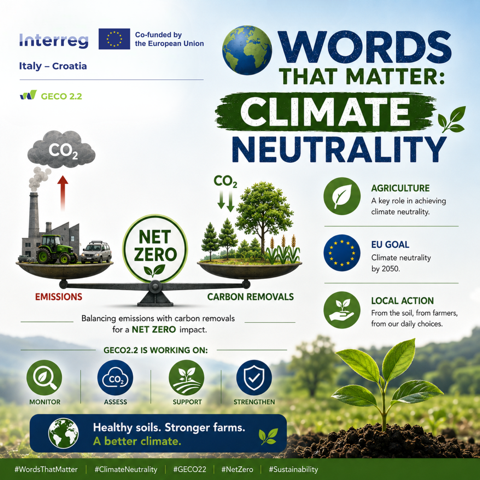
Climate Neutrality
Climate neutrality means achieving a balance between greenhouse gas emissions and the amount of CO₂ removed or sequestered from the atmosphere, so that the overall impact on the climate is neutral.
Under the European Climate Law (Regulation (EU) 2021/1119), the European Union has committed to achieving climate neutrality by 2050. Agriculture has a crucial role to play in reaching this objective. Through sustainable farming practices, improved soil management and carbon farming systems, agriculture can contribute significantly to climate mitigation efforts. GECO2.2 supports this transition by developing tools to monitor soil carbon stocks, assess agricultural greenhouse gas emissions, implement carbon farming systems and strengthen transparent carbon markets. Climate neutrality is not only a global ambition. It begins locally — in the soil, through farmers’ actions and through the choices made every day. As the project approaches its conclusion, the conversation continues. Through “Words That Matter”, GECO2.2 aims to contribute to a broader understanding of the concepts that will shape the future of agriculture, sustainability and climate action. Because building a sustainable future starts with knowledge.